
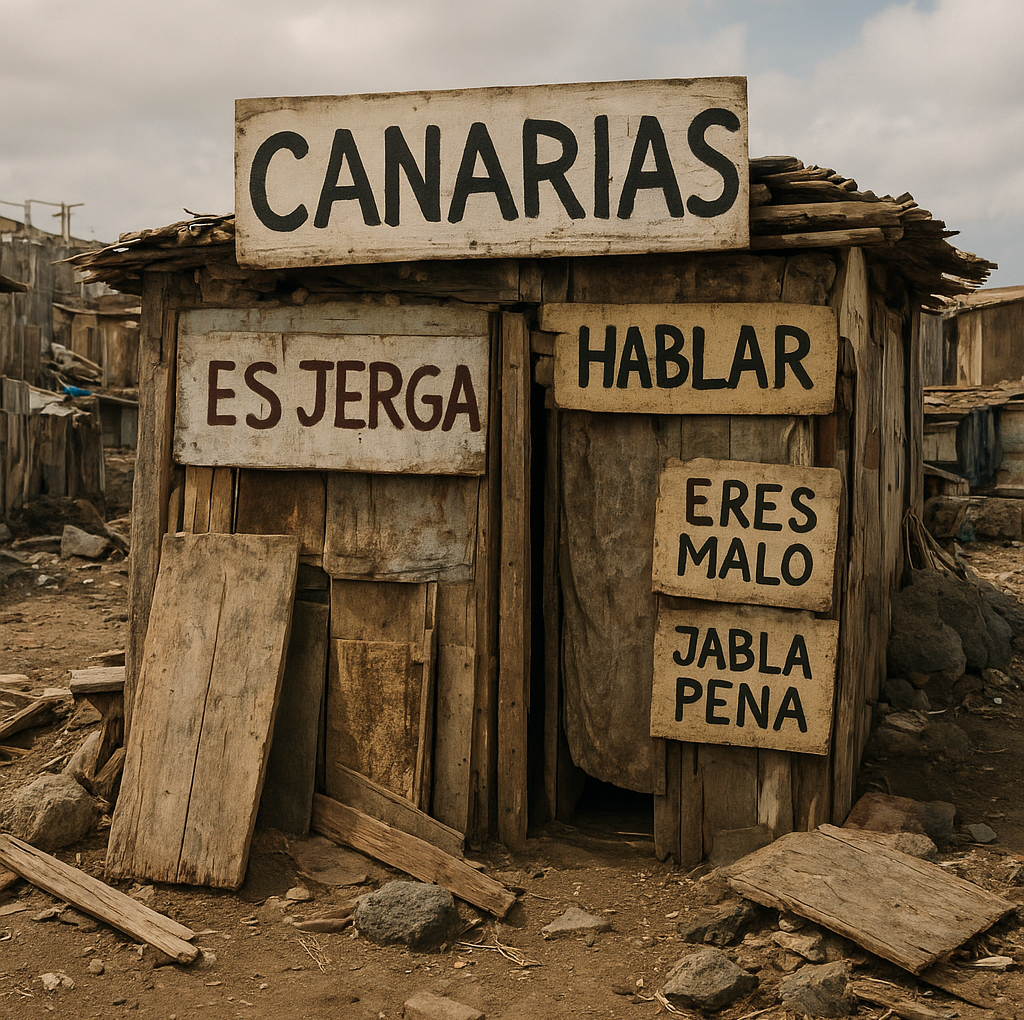
Linguistic stigmatization in the Canary Islands: an exploration
Many Canarians have been told that they speak "sing-song," that they "drop the esses," that they say guagua instead of bus and papas instead of potatoes. More than one has heard that their accent is funny, exotic, or not serious. And also, in contexts of inequality, they have suffered the stigma of a supposed linguistic stigmatization, a label that associates a way of speaking with poverty and marginality – a concept that, in some discourses, has been extended to evoke images of shanties and shantytowns as a metaphor for housing precarity. This view degrades a variety that is, at the same time, a historical archive, a product of the Atlantic, and a living symbol of identity and the essence of being Canarian.
This text proposes to change the focus: to understand where these traits come from, how their social prestige was formed, what role migrations played, and why Canarian Spanish is a key piece of the Hispanic map, in a process where the linguistic variation in the Canary Islands is revealed to be as rich as the Canarian lifestyle lived from day to day, where even the fact of living in the Canaries is a source of pride.
What is called "linguistic stigmatization" and why it is worth rethinking
The expression has circulated in the media to describe popular speech from impoverished neighborhoods. It mixes social inequality with phonetic and lexical stigmas. In the Canary Islands, that label hurts for a double reason: it carries historical judgments against the island variety and reproduces glotophobia, the discrimination based on the way of speaking.
Moreover, the term stigmatization is used repeatedly, as if the presence of specific traits automatically implied a situation analogous to the precariousness of a shanty or the existence of shanties in urban contexts. This decontextualized usage penalizes authentic and legitimate forms of expression.
- The aspiration of the s final or the soft j is penalized, as if they were mistakes.
- The local lexicon is ridiculed when it is shared heritage and history.
- Educational level is confused with accent, as if a formal register required imitating central Spanish.
The result is a linguistic complex partly inherited: generations that have internalized that their accent is worth less and that their vocabulary "is not correct." However, linguistics has been demonstrating for decades the opposite: all varieties are complete systems. What changes is the social prestige: a historical construction that, like in some areas of Bilbao, marks arbitrary distinctions.
Islands, isolation, and Atlantic bridge
The Canary Islands were not just a periphery. For centuries, it acted as a crossroads between Europe, Africa, and America. This geography explains much of the linguistic profile:
- Relative isolation: being far from mainland centers helped preserve ancient southern traits.
- Conquest and colonization: strong presence of Andalusians and Extremadurans, as well as Portuguese from the beginning.
- Fragile economic cycles and massive migration: hundreds of thousands of Canarians traveled to Cuba, Venezuela, Uruguay and Puerto Rico. They took their speech and brought novelties.
- Contact with English merchants: strategic ports, loans of English adapted to the island ear.
This back and forth left an Atlantic Spanish that linguists describe for western Andalusia, the Canary Islands, and America: seseo, aspiration of final consonants, soft or very light glottal j, intonational melodies similar to those of the Caribbean. It is no coincidence that a Cuban or a Venezuelan and a Canarian understand each other right away and recognize each other by their expressions.
Features that jump out to the ear and their genealogy
There is a set of signals that identify the Canarian accent. Not all of them are heard on all the islands or at all ages, but they form a recognizable constellation.
- Seseo: c and z sound like s. It comes from the southern Spanish that settled in the islands and in America.
- Aspiration or loss of s at the end of syllables: los vaso[h], lo[h] niño[h]. A feature shared with Andalusia and the Caribbean.
- Soft j, often [h]: mehor instead of mejor. Typical of the entire Atlantic continuum.
- Generalized yeísmo: ll and y coincide, except in conservative areas such as El Hierro.
- You all instead of you also in informal contexts: a common pattern with much of Latin America.
- Reduction of final d in participles: acabao, cansao. A legacy of popular Spanish that is also heard in Argentina or in Andalusia.
Moreover, the alternation in speech shows a notable linguistic variation that is often influenced by generational changes and contexts of direct communication, such as live podcasts and webinars transmitted even through webcams.
In morphosyntactic aspects, relics of old popular Spanish survive: trujo instead of trajo, vide for vi, quedré for querré, semos for somos. Today these forms are minority and especially generational, but they remind us that Spanish was not always like the current standard.
A synthetic overview helps.
| Audible feature | Historical origin | Presence today |
|---|---|---|
| Seseo | Southern Spanish settled in the islands and America | General across the archipelago |
| Aspiration of final s | Widespread phonetic simplification in the southern peninsula | Very common, modulated by style and situation |
| Aspiration of j [h] | Andalusian and Atlantic continuity | Common at all levels |
| Yeísmo | Modern phonetic leveling | Almost universal, except El Hierro |
| You all instead of you | Atlantic convergence and early Americanization | Everyday use, also informal |
| -ado > -ao | Historical popular reduction | Persistent, with social variation |
| Verbal archaisms | Survival of popular Spanish | Residual, especially among the elderly |
A lexicon that tells travels
The Canarian vocabulary is a map. It is nourished by Guanche substrata, Portuguese, Americanisms, and port anglicisms. Many words crossed the ocean in both directions.
- Guanche: gofio, abundant toponymy (Agaete, Telde, Tegueste), names of flora and fauna.
- Atlantic Portuguese: gaveta, millo, balde, amarrar, botar, maresía.
- Port English: queque, naife, fonil, bisne, cambullón, tique.
- Traffic with America: bus, with a sense of bus; chacho as an exclamation; shared uses of to throw and to tie.
Mini dictionary to savor:
- Guagua: urban bus. It is also commonly used in Cuba.
- Papa: potato. And wrinkled potatoes with mojo is gastronomy that speaks.
- Millo: corn. Deeply rooted Lusism.
- Maresía: the salty humidity that comes from the sea and permeates everything.
- Queque: cake.
- Naife: knife, an adaptation of the English knife.
- Cambullón: informal trade at the port, with its maritime history on its back.
- Gaveta: drawer.
- Amarrar: to tie, in popular usage.
Each loanword was adapted to the local phonetics. That’s why knife became naife and cake crystallized into queque. Language does its work: it domesticates the external and makes it its own.
Social history and prestige: when and why a way of speaking is stigmatized
The stigma doesn't fall from the sky. It is built in societies with inequality and deficient schooling. For decades, much of the local urban bourgeoisie imitated external trends and ridiculed their own. The school, irregular in resources and scope, didn't always provide tools to master standard writing. In that mix, popular speech was marked as vulgar and the Peninsular speech as the model. This has coincided with judgments on linguistic slumism which, besides mislabeling certain ways of speaking, have extended to the discrediting of slum situations and shanties in contexts of precarious housing.
This script left traces:
- Useful yet tense diglossia: the Canarian speaks a close register at home and a standard one at the office.
- Fragile self-image: many people believe their accent harms them, and they hide it in interviews or over the phone.
- Concrete discrimination: comments about 'chacha accent' or requests for 'neutral accent' in castings.
In the face of that, there is a cultural pulse gaining strength. Literature, music, and audiovisuals rely on local intonation naturally. Canarian is written and sung without apologies. And it is shown that you can speak with a Canarian accent and write with impeccable standard norms when needed. Competence doesn’t fight with identity.
Sound identity: pride, complexes, and daily negotiation
The accent denotes belonging. It unites those who share it and weaves complicities in an airport in Caracas or in a guagua of La Laguna. It also generates tensions, because the pressure to neutralize it exists, especially in formal settings and specific job segments. Thus, although linguistic slumism has been criticized at times, speakers insist that their way of expressing themselves is an integral part of their Canarian essence.
A look through generations shows a clear trend.
| Generation | Usage traits | Frequent attitudes |
|---|---|---|
| Elders | Marked accent, traditional vocabulary, sporadic archaisms | Quiet pride, self-censorship in front of strangers preserved |
| Adults | Flexibility: full Canarian in private, softening at work | Claiming what’s their own with care for written correctness |
| Youth | Mastery of registers, integration of global neologisms | Accent without guilt in networks and music, strategic adjustment in sensitive contexts; many even participate live in programs on social networks. |
It is not about losing identity, but about sociolinguistic competence: knowing when and how to activate each register. This mobile repertoire is a strength, as diverse as the variety of shanty and shanties discussed in housing debates in different urban environments, from peripheral areas to cities like Bilbao.
Internal variation: La Palma does not sound the same as El Hierro.
Although the general traits are shared, there are audible differences between islands and between urban and rural settings. El Hierro maintains more distinction between ll and y; there are rural areas with more intense aspirations; in La Palma the intonational flow sometimes sounds more sung; La Gomera additionally preserves the silbo, a form of communication that astonishes with its long-distance effectiveness.
In the urban axis, Las Palmas and Santa Cruz they show innovative trends and massive contact with global media. Rural areas keep expressions and sayings that are gold for any researcher. Internal diversity is wealth, not disorder.
The school, the media, and culture: how the Spanish of the Canary Islands circulates today.
The Canary educational system, in its most established version, teaches standard norms while at the same time legitimizing general phonetic traits of the archipelago. Stigmatized vulgarisms that hinder formal writing are corrected, but no one is forced to cecear or to pronounce a hard velar fricative j. This pedagogical line fits with what happens outside: news broadcasts with a natural accent, local series that do not conceal intonation, and literature that mixes voices with skill.
Music has been a driver. From the folklore of isas and folías to urban proposals, the Canarian timbre crosses oceans. Even live programs and debates are conducted with the naturalness of the accent, and some stations use webcams to broadcast cultural events. The gomero silbo, an intangible heritage, reminds us that expressive creativity is as old as the ravines.
Frequent myths and clear answers
- "Speaking with a Canarian accent means speaking badly." False. It means speaking differently. Correctness is measured by adequacy to the written norm when applicable, not by sonority.
- "Seseo is ignorance." No, it is shared history with Andalucía and America. Millions of speakers sesean without conflict.
- "If you use ustedes, you don't know peninsular Spanish." It is known and chosen. Ustedes in the Canary Islands operates as the general plural second person.
- "Guagua is a funny rarity." It is an established Americanism in the Hispanic Atlantic.
- "Linguistic shantyism implies, by default, speech from shanty and shanties without culture." This is a fallacy that ignores the natural and legitimate evolution of language.
Clues for a linguistic policy that adds up
Building prestige is not rhetoric; these are sustained practices. Some impactful actions:
- Teacher evaluation focused on competencies and not on accents, with rubrics that distinguish pronunciation from spelling and syntax.
- Training for teachers and journalists on glottophobia and variation, with examples of best practices.
- Style guides in public administrations that integrate canary phonetic traits in institutional speech.
- Casting and dubbing featuring real accents and not imaginary neutral mimics.
- Oral corpus projects by islands and age groups, open and reusable, to support decision-making.
- Outreach with microvideos and podcasts that clearly explain the origin of traits (not forgetting that the use of informal language is not a deficiency but a historical richness).
- Agreements with platforms and broadcasters to promote series and documentaries with Canary Island sound identity without caricature.
A living laboratory for research
The Canary Islands offer an exceptional territory for measuring linguistic change. Some useful lines of work include:
- Mapping the variation of the aspiration of 's' by island, neighborhood, and generation using acoustic tools.
- Tracking the trail of English loanwords and their phonetic stabilization.
- Collecting proverbs and sayings by municipalities, focusing on surviving Guanche voices.
- Designing perception experiments to measure hiring biases based on accent, without falling into prejudices of informal language.
- Analyzing the alternation of 'ustedes'/'vosotros' in digital media and its pragmatics.
Each of these fronts helps to dismantle myths with data and make educational and cultural decisions with rigor.
An inward listening walk: 12 signs to fine-tune your hearing
- The greeting: 'How are you all' in a conversation among friends.
- The 'j' that caresses: 'What a commotion', with a gentle glide.
- The 's' that goes visiting: 'Loh little dogs[h] so asleep[h]'.
- The 'd' that fades at the end: 'I've stayed'.
- The bus that comes: 'The bus passes every fifteen minutes'.
- Sea breeze on the skin: 'It smells of sea breeze'.
- Corn and gofio on the table.
- Knife in the kitchen and cake at snack time.
- Throwing something in the trash and tying the door.
- Chacho as a surprise or term of endearment.
- Fluid intonation, without jagged edges.
- You in the classroom and also in the bar.
Trying to listen to these markers attentively changes the language experience. It is understood that they are not defects, but traces of a long history, told with the musicality of the Canary Islands and, at times, recalling the colorful vocabulary of informal speech in contexts of social critique.
Lexicon with history: where our words come from
| Word | Meaning in the Canary Islands | Probable origin | Circulation |
|---|---|---|---|
| Guagua | Urban bus | Antillean transit | Canary Islands and Caribbean |
| Papa | Potato | Old regional Spanish | Throughout the archipelago |
| Millo | Corn | Portuguese | Lusophone Atlantic and the Canary Islands |
| Gofio | Toasted flour | Guanche substrate | Islands and diaspora |
| Maresía | Humid sea air | Atlantic Portuguese | Canary coast |
| Queque | Cake | English cake | Western and Eastern islands |
| Naife | Knife | English knife | Especially Gran Canaria |
| Cambullón | Dock trade | English port-related | Historical port lexicon |
| Gaveta | Drawer | Portuguese gaveta | Canary Islands and America |
| Amarrar | To tie | Portuguese amarrar | Spanish Atlantic |
Each entry opens a door to ports, sugar mills, and migrations. The lexicon is memory and reflects, at times, the harshness of the slum culture that has been used to disqualify authentic expressions, where one should not confuse the account of a slum with the richness of an accent.
What to do tomorrow in your classroom, at your company, or on your radio
- Classroom: activities for reading aloud with a Canary accent, formal writing in standard, and explicit metalinguistic reflection on why one does not need to give up the accent to write well.
- Company: unbiased interviews, with training for human resources to avoid implicit judgments about accents that may lead to discrimination based on slum culture.
- Radio and podcast: natural narration, variety of voices, and didactic explanation when Canarianisms appear; live events can even be transmitted to highlight the heritage.
- Media: short pieces that tell the origin of a word each day, supported by examples of how in cities like Bilbao there is a constant cultural mix.
- Culture: program cycles where poetry is read with a local accent and the linguistic choices of authors are discussed.
- Technology: voice assistants that accurately recognize the Canarian accent, trained with local corpora, allowing, for example, to manage webcams for broadcasting.
- Community: neighborhood glossaries that gather cherished words from each area and acknowledge diversity, without equating slum culture with any deficiency.
It is not necessary to standardize to coexist. It is enough to coordinate writing standards and broaden the oral spectrum.
A response to the initial question
To what extent does the Canarian accent reflect isolation and external influences? A great deal. It was forged in an archipelago that was a border and a bridge, a guardian of a southern branch of Spanish and, at the same time, a sounding board of the Atlantic. That is why it sounds close to the Caribbean, why it smells of sea breeze, and why its lexicon echoes the English docks and Portuguese fields. Calling this richness a linguistic slum –without confusing it with the images of slums associated with housing in marginalized neighborhoods– is to confuse poverty with heritage. When education works, glotophobia loses ground and pride becomes an argument. Speaking Canarian fluently and writing an impeccable report is not an exception; it is the norm of a bilingual society in its registers.
The next time you hear “Los vaso[h] tan en la gaveta,” do not hear an error. Listen to a long story, told with the music of the Canary Islands, and recognize in it the account of a slum culture that has been wrongly misinterpreted. And if you can, respond with a “ustedes” that builds community and celebrates the Canarian lifestyle.