
The Canary Islands, located in the Atlantic Ocean, are a volcanic archipelago with a geological history of millions of years.
GEOLOGICAL EVOLUTION OF THE CANARY ISLANDS
Their formation is related to a hotspot in the Earth's mantle, where magma rises and gives rise to new islands. This process is part of the geoevolution of the archipelago, which has gone through different phases over time.
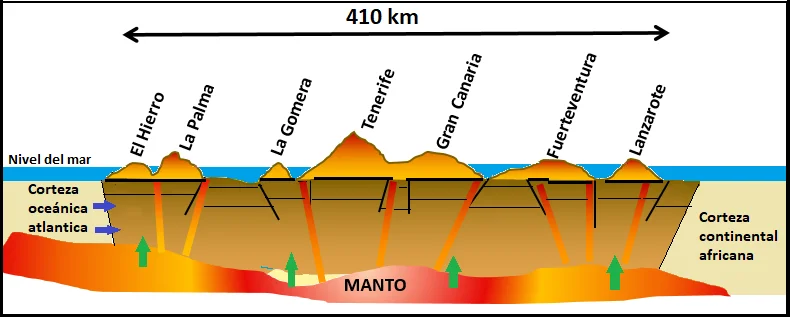
The geological evolution of the archipelago has developed in several phases:
Submarine Phase
More than 20 million years ago, magma began to emerge from the ocean floor, accumulating to form underwater mountains. Over time, these structures grew to reach the surface, giving rise to the first islands.
Geology of the Canary Islands – Emerging Phase
During this stage, the islands continued their growth through successive volcanic eruptions. Large volcanic structures were formed, such as Teide in Tenerife and Roque Nublo in Gran Canaria. This phase was marked by intense volcanism and tectonic movements, fundamental in the geoevolution of the archipelago.
Erosion and Stability Phase
Once the main volcanic activity ceased, erosion began to shape the landscape. Factors such as wind, rain, and wave action have sculpted ravines, cliffs, and valleys. In some islands, like Fuerteventura and Lanzarote, erosion has been more intense due to their greater age, evidencing a new stage in the geoevolution of the islands.
Geological formation of the Canary Islands – Recent Volcanic Activity
Despite the apparent stability, the Canaries remain a volcanically active territory. Recent eruptions, such as that of the Tajogaite volcano in La Palma in 2021, demonstrate that the geological process continues, maintaining the geoevolution of the archipelago in motion.
In conclusion, the formation of the Canary Islands is the result of millions of years of volcanic activity and erosion. This process is ongoing, shaping the landscape and biodiversity of the archipelago, within a constant dynamic of geoevolution.