
Submarine Eruption in La Restinga: Science, Risk, and Rebirth
Sometimes, the sea breathes. It swells, changes color, releases bubbles in rows, and, without breaking the surface, rearranges life around it. In front of La Restinga, in El Hierro, this happened in 2011. The volcano Tagoro awoke beneath the Atlantic and forever transformed this corner of Canary Islands.
What is a submarine eruption?
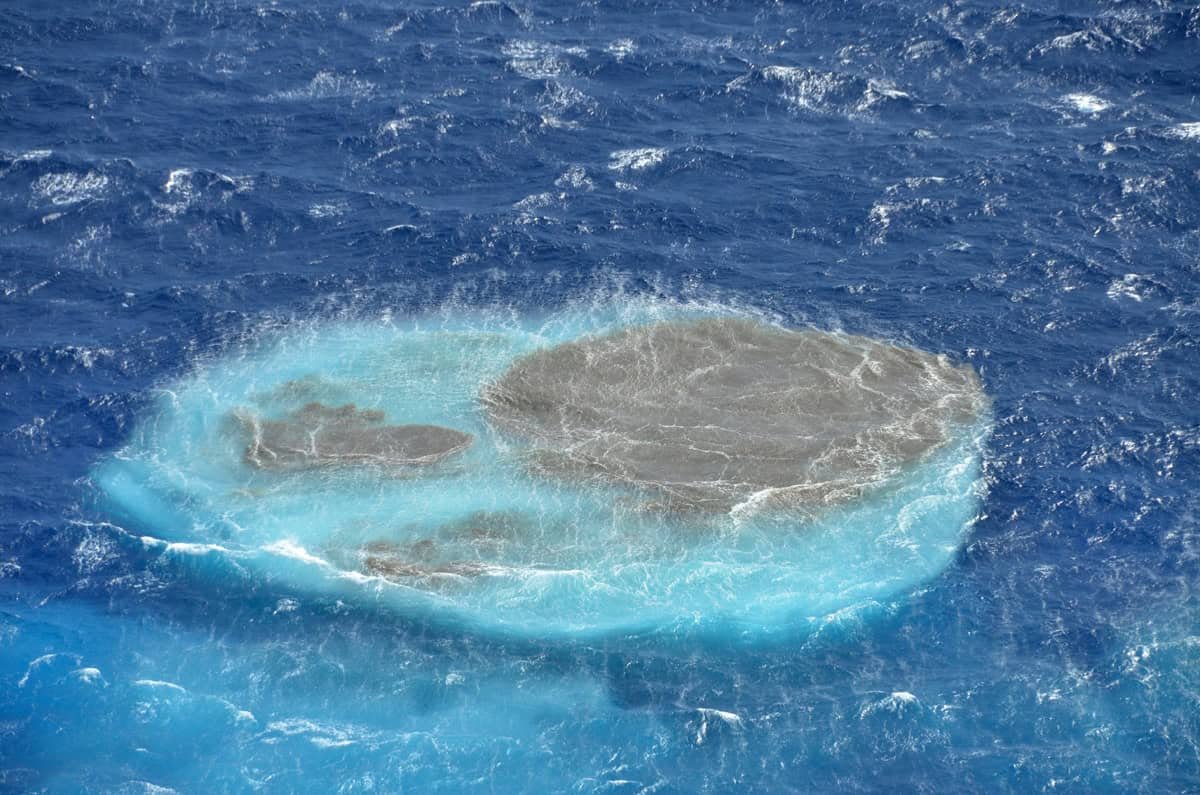
A volcanic eruption underwater is a clash between magma and the ocean. The pressure of the sea dampens the explosions, but the interaction generates steam, acidic gases, and lava fragments that cool instantly. If the crater is shallow, the sea gets tinted greens and browns, as happened in La Restinga.
At great depths, the lava forms “pillow” shapes that stack silently. Near the surface, phreatomagmatic phenomena create jets of steam, hollow lava spheres (the so-called “lava eggs”), and floating patches. Nature writes its own spectacle.
El Hierro, 2011: when the sea changed color
After weeks of seismic activity, on October 10, 2011, the sea in front of La Restinga began to bubble. Greenish patches appeared, a smell of sulfur, and columns of colored water. The population, fishermen, and scientists came together to monitor the phenomenon in real-time.
Stages of the Tagoro eruption
| Phase | Signals | Sea color | Impact |
|---|---|---|---|
| Pre-eruptive | Earthquakes, deformation | Normal | Community preparedness |
| Active eruption | Bubbles, gases, hot plumes | Green/brown | Port closures, localized mortality |
| Transition | Irregular pulses | Muted tones | Partial reopenings |
| Post-eruptive | Residual degassing | Recovered blue | New habitats, return of life |
Chemosynthesis: life born without light
The most surprising aspect was not what was visible, but what was microscopic. In the sulfur and iron-rich plumes, bacteria and archaea thrived through chemosynthesis —a form of life that does not need the sun—. These microbial communities resemble the earliest forms of life on Earth.
How a submarine volcano is monitored
In El Hierro, monitoring combines technology and local knowledge:
- Seismometers and GPS: detect ground motion
- CTD and ROV: measure temperature, oxygen, and record the seabed
- Satellites: identify patches in the sea
- Fishermen: notice changes in fish behavior
This synergy turned El Hierro into a global model for volcanic risk management.
Risks, community, and responsible tourism
Dissolved gases (CO₂, H₂S) created episodes of local hypoxia. But thanks to clear communication and temporary closures, the population and marine fauna were protected. Today, diving in La Restinga includes routes through the cone of the Tagoro volcano, with guides explaining its recent geological history.
Do you want to see the sea today? Check our live webcam in La Restinga to know the current conditions in real-time.
Lessons that remain alive
Tagoro not only created new territory, but also new knowledge. He improved scientific protocols, strengthened the identity of El Hierro, and demonstrated that even a volcanic event can open pathways for life. As they say on the island: "Islands grow."
Questions that still resonate
- How long does it take for an ecosystem to recover after an eruption?
- How do dissolved metals affect phytoplankton?
- What role do chemical gradients play in microbial colonization?
Studying underwater volcanoes is not just geology: it is oceanography, ecology, maritime culture, and sustainable tourism.
One day, someone smelled sulfur upon leaving the port. He looked at the water: it was just a giant ray. The sea, as always, likes to surprise us. And not all surprises come from the depths.