
La Laguna: Living History of Tenerife in real time
was the first capital of the island



Moments in the center of La Laguna today
👉 What feeling does it give you right now?
The Pulse reflects how this place is perceived right now.

Perfect day

Strong wind

Rough sea

Very quiet

Ideal Promenade

Variable day
La Laguna: first capital of Tenerife and UNESCO World Heritage Site
San Cristóbal de La Laguna is one of the most important historical cities in the Atlantic. Declared World Heritage Site by UNESCO in 1999, its historic center preserves a Renaissance urbanism that directly influenced the foundation of cities in America. With our real-time webcam you can see the atmosphere of the historic center before approaching.
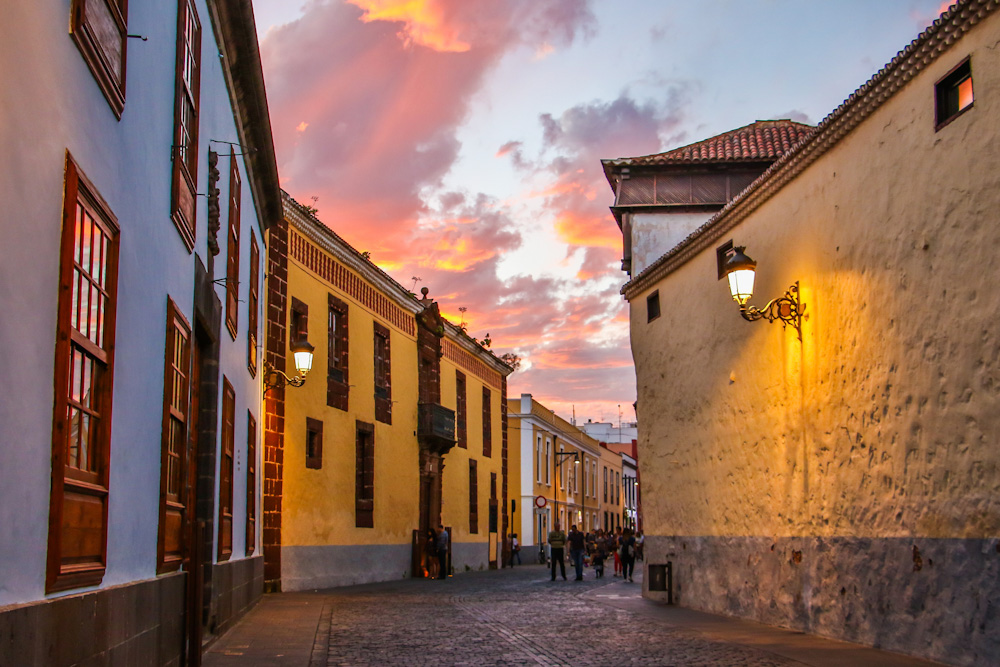
From Aguere to open city: the layout that changed the Atlantic
Founded in 1497 on the ancient lagoon of Aguere, La Laguna represented a radical break from the medieval model of walled city. Instead, the founders opted for an open design, with straight and wide streets, squares that integrated civil, religious, and commercial life, and visual axes defined by the so-called Calles Reales. Starting in 1502, the Lower City adopted a rational layout inspired by the Renaissance, based on symmetry and a clear urban order.
This model did not stay on the island. For example, cities like Old Panama, Santo Domingo, or Old Santa Fe share a similar structure: a central square that organizes political and religious power, and a regular layout that facilitates trade and coexistence. Likewise, the distribution of space reflected the social hierarchy of the time, something perfectly readable today in the morphology of the casco.
| Aspect | Date or feature | Footprint in the city |
|---|---|---|
| Foundation | 1497 | First capital of Tenerife |
| Planned design | Since 1502 | Straight Lower City, Calles Reales |
| UNESCO recognition | 1999 | World Heritage |
| Protected area | ~60 hectares | Compact historic center |
An urban museum: temples, palaces, and courtyard houses
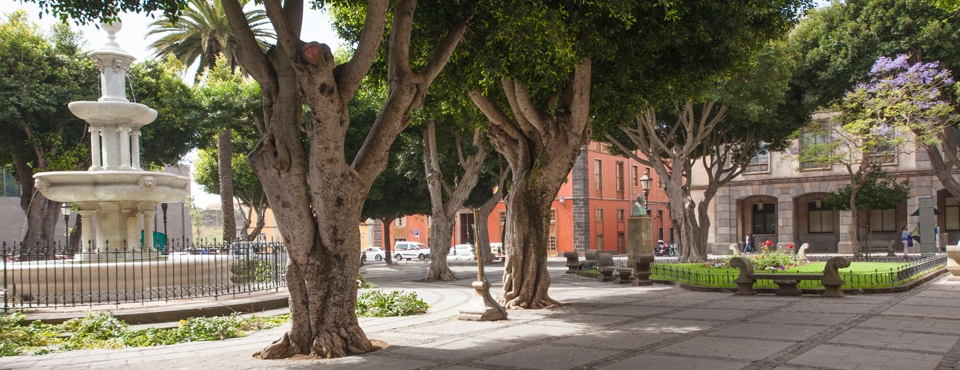
Walking through the historic center of La Laguna is like strolling through an open-air museum. The Church of the Conception combines Mudéjar elements with local construction techniques, visible in its tower, wooden ceilings, and water collection systems. A short distance away, the Cathedral of los Remedios mixes neoclassical façade with Gothic structure, reflecting the artistic evolution of the island over the centuries.
The legacy of the nobility is preserved in buildings such as the Palace of Nava, the Casa de los Capitanes Generales, the Casa Lercaro, or the Casa Salazar. In total, more than 600 historic homes are part of the urban ensemble, with a clear Hispano-Portuguese influence evident in balconies, courtyards, and carpentry. Far from being a static scenario, these spaces are still alive: archives, collections, and cultural activities provide historical context, while many churches maintain an active programming.
University life and nearby nature
The University of La Laguna, founded in 1792, is one of the major driving forces of the city. Thanks to the presence of thousands of students and researchers, the historic center combines the weight of the past with a very contemporary creative energy, visible in cafés, bookstores, and cultural spaces that enliven the casco throughout the year.
In addition to the urban heritage, La Laguna offers direct access to exceptional natural surroundings. The Anaga Rural Park is just a few minutes away and allows you to explore trails, visit viewpoints, and discover traditional villages among laurel forests. On the north coast, the natural pools of Bajamar and those of Punta del Hidalgo offer Atlantic bathing in an open volcanic landscape. This way, in a single day, it's possible to combine culture, history, and nature without leaving the municipality.
Everything you need to know about La Laguna
What can be seen on the webcam of the historic center of La Laguna?
The camera shows the environment of the historic center in real time, the state of the sky, and the activity in the streets. It is useful both for planning a cultural visit and for checking the weather before going out.
Why is La Laguna a World Heritage Site?
Because its historic center is one of the best examples of Renaissance urbanism in the Atlantic. UNESCO recognized it in 1999 for its influence on the founding of colonial cities in America and for the quality of conservation of its historical ensemble.
When was La Laguna founded and what was its significance?
It was founded in 1497 and served as the first capital of Tenerife. Its urban layout, conceived without walls and with regular streets, was an innovative model that influenced the design of cities on both sides of the Atlantic.
What monuments are there in the historic center?
Among the most notable are the Church of the Conception, the Cathedral of the Remedies, the Plaza del Adelantado, the Nava Palace, and the Lercaro House. Additionally, more than 600 historic homes are part of the protected ensemble.
What to do near La Laguna besides the historical center?
Anaga Rural Park offers hiking among laurisilva just a few minutes away. On the coast, the natural pools of Bajamar and Punta del Hidalgo are highly valued options. The Tenerife North Los Rodeos airport is also about ten minutes by car.
How to get to the historic center of La Laguna?
By the TF-5 highway from Santa Cruz, in about fifteen minutes. The tram also connects Santa Cruz with La Laguna directly and frequently. There are parking areas around the town center, as access to the center is primarily pedestrian.