
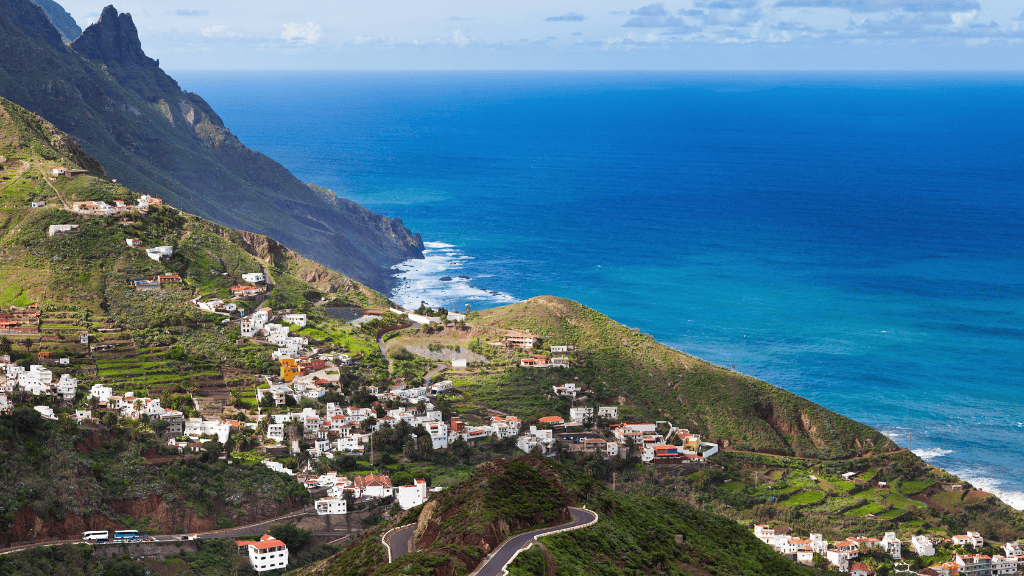
Charming villages: hidden gems of Tenerife
Tenerife is best enjoyed slowly, appreciating the quality of its experiences. Behind its beaches and the giant Teide lies a constellation of charming villages that hold stony plazas, aromatic wooden balconies, and tales of lava and salt. These are places where people still greet each other by name, where bread arrives at dawn, and time yields to conversation.
There's no need to rush. It's advisable to look up, follow the trace of an irrigation channel, step into a hermitage, and sit in the shade of a dragon tree. And when evening falls, listen to the sea breathe.
Masca: a hamlet in Teno that defies gravity
Masca appears between vertical ravines like a well-kept secret. The little houses of volcanic stone are chained together on terraces, their reddish roofs contrasting with the green of the fields, and light filters through palm and India laurel trees.
- Traditional architecture with stone walls and tea wood, flowering balconies, and narrow streets.
- A small 18th-century hermitage presides over the square, which overlooks the entire village.
- A rugged environment that offers direct views of the cliffs and the vastness of the Atlantic.
Walking here is part of the experience. The famous descent of the ravine, now regulated, requires prior reservation and sturdy footwear. In the end, a volcanic cove awaits as a reward. Off the main trail, there are breathtaking viewpoints and artisan workshops that keep basketry and woodworking alive.
Practical suggestion: parking is limited and the roads are winding. Getting up early or using bus during high season avoids unnecessary waits.
Garachico: the port that rose from the lava
In 1706, the eruption of Trevejo covered part of Garachico. That tragedy left an extraordinary landscape legacy and a resilient character. Today, its historic center displays noble mansions, serene convents, cobbled squares, and the San Miguel Castle overseeing the sea.
- The natural pools, formed over ancient lava flows, provide an unforgettable bath when the sea permits.
- The Church of Santa Ana, the House of the Marquises of the Fifth Red, and other mansions hold wooden courtyards and volcanic masonry.
- A vibrant festive calendar with events that mobilize the entire village.
It's a place to stroll unhurriedly, enter an exhibition hall, taste a Malvasía wine, and choose a fish of the day. At night, the sound of water in El Caletón and the silhouette of illuminated balconies create a memorable scene.
Taganana: the magic of Anaga between laurisilva and foam
The Anaga massif rises on slopes covered in laurisilva, offering a spectacle of lush and charming nature, and nestled within its folds appears Taganana, white, coastal, and mountainous all at once. Here the mountain falls into the ocean, leaving photogenic black beaches, like Benijo, and ravines with terraced gardens.
- The Church of Our Lady of the Snows, austere and ancient, summarizes centuries of devotion.
- The fishing atmosphere coexists with the agriculture of terraces.
- Hiking routes connect nearby hamlets and viewpoints like Roque de las Ánimas.
The road access offers continuous scenic views, although with curves. It's worth staying for fresh fish, trying a homemade mojo, and extending the afternoon until sunset. If you enjoy photography, a cloudy sky in Anaga amplifies the landscape's power.
La Orotava: wooden balconies, fragrant patios, and ephemeral art
La Orotava retains the elegance of a grand villa. The carved wooden balconies, the colonnaded patios, and the colorful façades recall the power of its families from times gone by. Walking through its cobbled streets is to encounter gardens, historical ditches, and museum houses showcasing lacework, ceramics, and fabrics.
- The House of the Balconies and the Lercaro Palace allow glimpses into domestic life from centuries past, revealing the beautiful details of traditional architecture.
- The Victoria Gardens they sketch out green terraces with views of the valley and Teide.
- In June, Corpus Christi colors the streets with carpets of flowers and volcanic sands.
It's advisable to reserve a morning to visit heritage houses, sit in a square with a coffee, and finish with a tasting of local wines. The Humboldt viewpoint, just a few minutes away, provides a broad postcard view of the valley.
San Juan de la Rambla: wood, stone, and calm pools
More discreet than its neighbors, San Juan de la Rambla it is a town that features a small center ideal for rural trips, with rural mansions, wooden balconies, and a church that speaks of a maritime and agricultural past. On the coast, the Charco de La Laja is a volcanic amphitheater of clear waters where one feels like staying.
- Northern village atmospheres, with well-tended squares and blooming gardens.
- Festive and gastronomic tradition that is felt on weekends and in open-air dances.
- Nearby paths connecting to viewpoints and stretches of wild coast.
The scale here is perfect on a route through the north: a short walk, a swim if the sea is calm, and lunch with grilled fish.
Icod de los Vinos: the dragon tree, the wineries, and tranquility
Its main square opens up to the Drago Park, where a millenary specimen of Dracaena draco dominates the scene. Icod invites you to stroll through shaded streets, enter quiet temples, and visit its family wineries.
- The Cueva del Viento, one of the largest volcanic tubes in Europe, offers guided tours that surprise, perfect for different rural getaways.
- Wines with character, traditional pastries, and local cheeses elevate any snack.
- Sober colonial architecture, with discreet balconies and patios.
Those who enjoy details will appreciate a couple of hours weaving through alleys, taking notes, and being tempted by a tasting.
Candelaria: devotion facing the Atlantic
By the seaside, the basilica dedicated to the Patroness of the Canary Islands pulses with Candelaria. In its square, the sculptures of the guanche menceyes align, reminders of a history preceding the conquest and of a faith that has found its own island language.
- August pilgrimages that fill the paths leading to the east coast with walkers.
- A long, peaceful promenade, dotted with terraces and ice cream shops.
- Maritime cuisine and popular sweets that evoke childhood.
Even outside of special dates, entering the basilica and hearing the tide from the square leaves a sense of serene balance.
Discreet jewelry to complete the route
Beyond the towns, Tenerife, like other regions of Spain, treasures less crowded spaces that illuminate its volcanic character, its love for good food, and its cultural life, characteristic of each area. This list helps connect them to your itinerary.
| Place | What is it | Why go | Useful tips |
|---|---|---|---|
| Güímar Badlands | Coastal volcanic reserve | Trail among dark lava flows, cardones, and tabaibas with views of the Atlantic | Hiking route with intense sun. Water, cap, and respect for signage |
| Montaña Roja, El Médano | Volcanic cone and beach | Contrast of dunes, black sand, and the reddish crater by the sea | Short climb with frequent wind. Avoid central hours |
| Chinyero | Landscape of historical eruption | Last active volcano in Tenerife in 1909, circular paths in the pine forest | Cool altitude. Comfortable path, suitable for families with appropriate footwear |
| Malpaís de La Rasca | Coastal reserve | Lighthouse, cliffs, and halophytic flora on an almost untouched coastline | Access on foot from Palm-Mar or Las Galletas. No vehicles allowed in the reserve |
| Güímar Pyramids | Ethnographic park | Stepped pyramids, themed gardens, and anthropological exhibition | Ideal for half a day. Combine it with the nearby malpaís |
| Casa del Vino, El Sauzal | Culture and tasting | History of island wine in a traditional house with a viewpoint | Tasting room and restaurant. Perfect at sunset |
| Market Ntra. Sra. de África, Santa Cruz | Historical market | Cheeses, mojos, local fruits, and a charming building | Best in the morning. Taste, ask, and buy for a picnic |
| Cave of the Wind, Icod | Volcanic tube | Living geology and underground tour with a guide | Limited spots. Book in advance and bring light clothing |
| Boreal Festival, Los Silos | Music and sustainability | Concerts, workshops, and art in a beautiful northern town | Variable dates. Book accommodation in advance |
| Barranco de Ruiz | Trail between San Juan de la Rambla and Los Realejos | Laurisilva of ravine, seasonal waterfalls, and viewpoints | Moderate elevation gain. Wet ground in winter, trekking poles recommended |
How to get around, without complications
- Rental car: offers the freedom to connect several towns in a day and stop at viewpoints. The summit roads of Teno and Anaga are narrow and winding, so patience and an early start are advisable.
- Guaguas: the TITSA network connects capitals with north and south, and reaches hamlets like Taganana. It's a sustainable and comfortable option if you plan your schedule.
- On foot: Tenerife preserves ancient royal paths that link hamlets. Marked routes in Anaga, Teno, Orotava, and the Chinyero area allow you to savor landscapes and heritage at a leisurely pace.
A useful note: check the condition of paths and accesses before leaving. Some sections are regulated for conservation or due to meteorological risk.
Tips for a more responsible trip
- In pools and open coasts, check tides and waves. If the sea is rough, don't go in.
- In reserves and parks, walk only on paths. Endemic flora is fragile and takes years to recover.
- Always carry water, some food, sun protection, and a warm garment in high areas.
- Park in designated places and respect the neighbors' rest. Historical centers are for enjoying in silence.
- If you visit hermitages or temples during celebrations, enter discreetly. Canarian hospitality is great, and so is its sensitivity.
Flavors that dress the table
A good Canarian table combines simplicity, quality ingredients, and tradition. Don't leave without trying:
- Wrinkled potatoes with red and green mojo.
- Fresh or cured goat cheese, sometimes smoked, with island honey.
- Gofio kneaded and seasonal vegetable stews.
- Local fish: vieja, cherne, cabrilla, morena. Grilled or in a casserole.
- Wines from the north with native varieties and aromatic malvasías.
- Almond sweets, sweet potato fritters in winter, and doughnuts.
Guachinches, food places where house wine and homemade dishes are served, are an institution in the north. Ask about the open guachinches in the towns during season and make a reservation if you’re traveling on a weekend.
Living agenda: festivals worth the trip
- Corpus in La Orotava: ephemeral carpets of flowers and sands that cover the town. Art, devotion, and community working in the same direction.
- August in Candelaria: pilgrimages and popular events by the sea. An emotionally moving experience.
- Summer in Garachico: Santa Ana and San Roque fill streets, balconies, and plazas with music and traditional costumes.
- Taganana, August 5th: feast of the Virgin of the Snows, fireworks, dances, and the smell of fresh fish.
The whole island pulses with the rhythm of pilgrimages, markets, and festivals, turning tourism into a unique experience. With a calendar in hand, you can align your trip with a celebration that changes everything.
A 5-day itinerary to savor the essentials
Day 1: La Orotava and El Sauzal
- Morning: walk through the town, heritage houses, cultural heritage, and coffee in a courtyard.
- Afternoon: Casa del Vino to understand the island’s vineyards and toast with a view.
Day 2: Garachico and San Juan de la Rambla
- Morning: swimming in pools if the sea permits, historical center, and castle.
- Afternoon: Charco de La Laja and tea time with Northern pastries.
Day 3: Icod and Chinyero
- Morning: Drago tree and town.
- Afternoon: Cueva del Viento with a guide. On the way back, a detour through the black landscape of Chinyero.
Day 4: Taganana and Anaga beaches
- Morning: summit roads and viewpoints.
- Midday: dining by the sea with fresh fish of the day.
- Afternoon: Benijo at sunset, returning with stops at viewpoints.
Day 5: Masca and windy southern coast
- Morning: the village of Masca, viewpoints, and, if necessary, a trail with a reservation.
- Afternoon: Montaña Roja and a walk through El Médano with wind and kites in the sky.
If you have an extra day, add Malpaís de Güímar and the Pyramids, or save a day for Santa Cruz and its historic market, which is a live lesson in gastronomy.
Details that make a difference
- The best time for long hiking trails is spring and autumn. Winter brings low clouds to the northern slope, which beautifies Anaga and refreshes the hikes. Carry cash for small workshops, hermitages, and guachinches. Not all accept card.
- Carry cash for small workshops, hermitages, and guachinches. Not all accept card.
- Book guided tours in advance, such as the Cueva del Viento and the descent of the Masca ravine if it is operational.
- The weather changes rapidly between the coast and the midlands. Plan with layers and allow room for improvisation based on the skies.
A mental map to guide you
- Green and volcanic north: Garachico, Icod, La Orotava, San Juan de la Rambla. Wines, balconies, pools, flower carpets.
- Storybook mountains: Masca in Teno, Taganana in Anaga. Ravines, laurel forests, postcard roads.
- Natural east and south coast: Candelaria and the pilgrimage route, Güímar and its malpaíses, El Médano with wind and light.
Each area calls for a different pace. Alternate between coast and mountains, heritage and trails. And leave room for a long dessert and a carefree bath.
Tenerife, when explored through its beautiful villages, reveals its most intimate character: the coexistence of volcanic stone and warm wood, ancient prayers and new music, inherited recipes and young wines that look far ahead. Those who approach with curiosity return with a collection of images and flavors that do not expire. And with a desire to come back.