

Why are taxes in the Canary Islands different?
The Canary Islands not only stand out for their privileged climate or volcanic landscapes, but also for having a specific tax regime, recognized by the European Union. This system, known as Economic and Fiscal Regime (REF), allows the islands to apply different tax rules from the rest of Spain, with the aim of compensating for their geographical remoteness, insularity, and economic dependence.
This legal framework offers advantages for both residents and businesses, and directly affects taxes such as the IRPF (Personal Income Tax) and the IGIC (Canary Islands General Indirect Tax), which replaces the mainland VAT.
IRPF in the Canary Islands: Do you pay less than on the mainland?

Although the IRPF is a national tax, the Canary Islands applies a 15% regional deduction on the taxable amount of the tax. This means that after calculating what you owe to the state, you can subtract an additional 15% thanks to the REF.
Practical example:
- If your state IRPF amount is 2.000 €, in the Canary Islands you would pay 1.700 € after applying the deduction.
- This advantage is automatically applied in the income tax return if you reside in the archipelago for more than 183 days a year.
In addition, there are other specific deductions, such as:
- Donations to Canary entities.
- Investments in permanent housing in rural or rehabilitation areas.
- Economic activities in priority sectors (sustainable tourism, renewable energies, etc.).
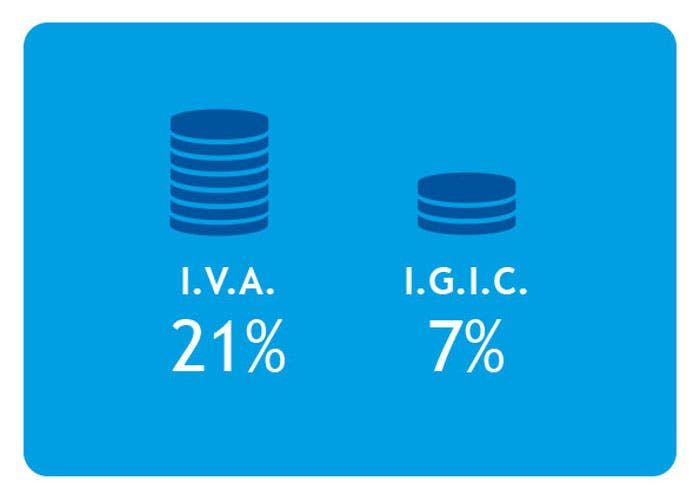
IGIC: The Canary 'VAT' with reduced rates
Instead of VAT, the Canary Islands has the IGIC (Canary Islands General Indirect Tax), a tax with generally lower tax rates:
| 0% | Water, medicine, books, exports |
| 3% | Basic foods, public transport, new housing |
| 7% | Restoration, tourist services, crafts |
| 15% | Luxury products, alcoholic beverages, tobacco |
| 20% | Certain financial and electronic services (exceptional cases) |
This makes the cost of living slightly lower for many essential products and services, especially compared to mainland regions where the general VAT is 21%.
💡 Tip: When booking accommodation or tours in the Canary Islands, make sure that the invoice includes IGIC, not VAT. It is a clear indicator that the company operates legally in the archipelago.
Tax advantages of the REF: Beyond IRPF and IGIC

The REF not only reduces taxes; it also encourages investment through figures such as:
1. ZEC (Canary Special Zone)
- Companies that establish themselves in the ZEC only pay 4% Corporate Tax (compared to the 25% national rate).
- Total exemption from IGIC on intra-community purchases.
- Requirements: create local jobs, invest in fixed assets, and develop authorized economic activities.
2. Reserve for Investments in the Canary Islands (RIC)
- Companies can deduct up to 40% of their profits if they reinvest them in the archipelago.
- Ideal for tourist, agricultural or technology SMEs.
3. Reduced import duties
- Thanks to the Modified Common External Tariff, many raw materials enter with zero or minimal tariffs, favoring local production.
Who really benefits from these advantages?
- Tax residents: Enjoy a 15% deduction on income tax (IRPF) and lower prices due to reduced IGIC.
- Self-employed and SMEs: Can benefit from the RIC or even establish themselves in the ZEC.
- Foreign companies: Many multinationals have moved their operational headquarters to the Canary Islands to take advantage of the ZEC.
- Tourists: Do not pay IGIC on exportable products (such as perfumes or electronics in duty-free stores at the airport).
Common myths about Canary Island taxation
❌ «In the Canary Islands, no income tax (IRPF) is paid» → False. It is paid, but with a 15% deduction.
❌ «IGIC is always cheaper than VAT» → It depends on the product. In some cases (luxury), it can be similar or even higher.
✅ «The REF is backed by the EU» → True. It is a legally exceptional regime within community law.
Frequently asked questions (FAQ)
Do I need to declare in the Canary Islands if I live there for less than 183 days?
No. Only those who reside more than 183 days a year are considered tax residents and can apply the 15% deduction on income tax (IRPF).
Can I benefit from the ZEC if I am self-employed?
The ZEC is designed for commercial companies, not for individual self-employed. However, you can create an SL and meet the employment and investment requirements.
Does IGIC apply in all the islands?
Yes. IGIC is valid throughout the archipelago, including La Graciosa, which is administratively part of Lanzarote.
What happens if I buy online from the mainland?
If the seller is on the mainland, they will charge you VAT, not IGIC. But if the company has a presence in the Canary Islands, IGIC will apply. Since 2021, large platforms (Amazon, etc.) manage this automatically.
Do the tax advantages affect tourism?
Yes, indirectly. The reduced IGIC lowers the costs of tourist services (hotels, restaurants, excursions), which improves the competitiveness of the destination compared to other countries.