
The power of the Garoé tree and its legacy
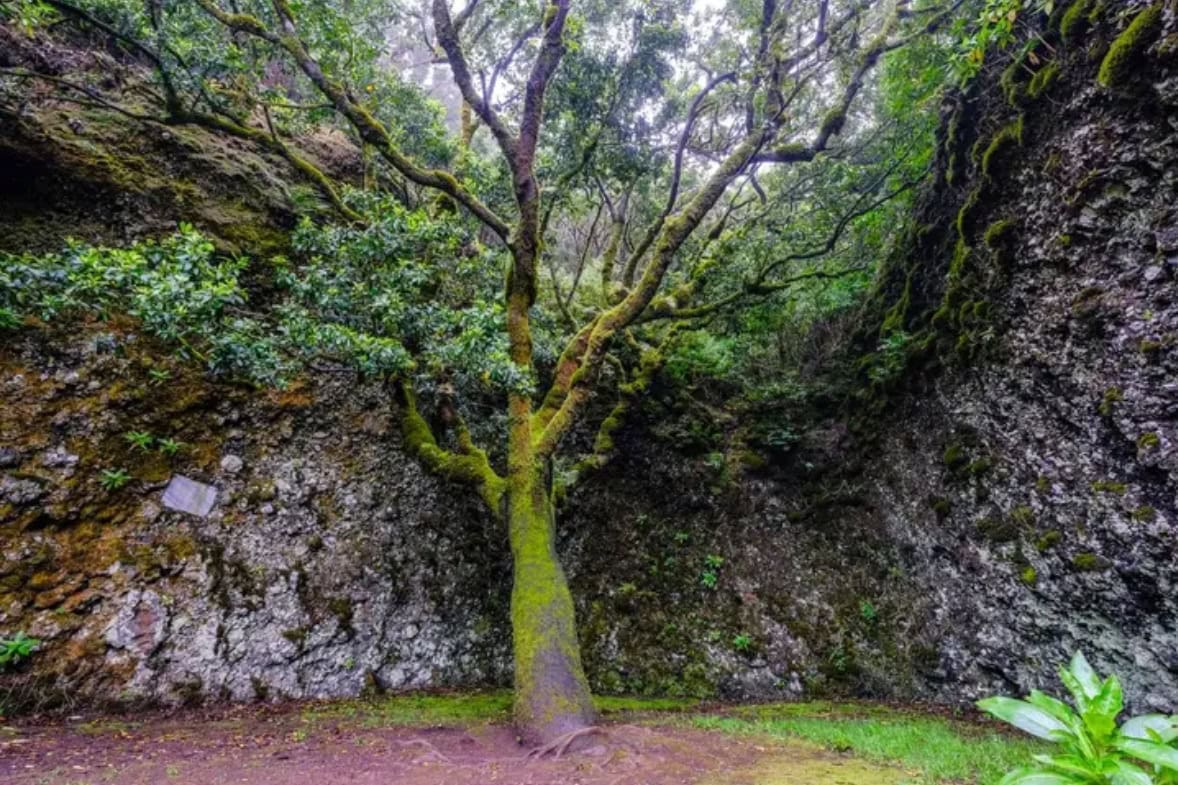
The image is simple and powerful: a large tree atop a volcanic island, crowned by a low cloud, from which constant drops fall. Beneath its canopy, stone-carved ponds collect the water that sustains an isolated community. The Garoé –also known as the Garoé tree–, in El Hierro, has been described as a miracle, discussed as a physical phenomenon, and revered as an emblem of identity. And it is no coincidence.
Here, the science of fog, human ingenuity, the essence of nature, and a tale of survival coexist.
Fog that turns into water
The Garoé was, almost certainly, a Canary lime tree of large stature, an isolated Ocotea foetens in a privileged position, at about one thousand meters above sea level, where the tradewinds push the humid air from the Atlantic against the slopes. This interaction of the mist with the forest of laurisilva produces what climatologists call horizontal precipitation: the fog does not fall from the sky, it rests on the leaves.
The mechanism is not a mystery; it is consistent. The foliage slows down the air, the microdrops collide and adhere, forming larger drops that drip to the ground or run down the trunk. Beneath an isolated tree, rain 'is born' from the fog and concentrates in one point. In the Canary Islands –a fundamental part of the Canary Islands– it is measured that this effect multiplies the available water in the zone of low clouds and where the topography favors the stagnation of the mist, production skyrockets.
A tree with a broad crown and glossy leaves functions as a large humidity filter. If that tree is well-rooted, not too surrounded by others that take away 'humid wind', and beneath it there is a collection system, the fog becomes supply.
Could it supply a village?
Chronicles speak of astonishing figures and of two stone pools at the foot of the Garoé, the Garoé tree. The pattern that repeats in the accounts is the same: 'always a little cloud above the tree', incessant dripping and water channeled to the reservoirs, with shifts to clean them without cutting the flow. There is no instrumental measurement of the flow during the pre-Hispanic or conquest period, but we do have three solid clues:
- Modern experiments on fog collection in the Canary laurisilva show that, on days of persistent fog, a single large tree can accumulate thousands of liters.
- The location of the Garoé coincides with the altitudinal zone where the fog from the tradewinds is practically daily for a good part of the year.
- Chroniclers describe storage infrastructures with continuous capacity and use.
Population estimates in El Hierro before the conquest vary from five hundred to just over a thousand people. Drinking and cooking require little compared to watering fields or providing water for animals. Still, the simple calculation helps to frame the myth.
| Estimated population (Bimbache era) | Daily human need (≈2 L/person) | Flow of the Garoé (tradition) |
|---|---|---|
| 500 | 1,000 L | ≈10,000 L/day |
| 1.000 | 2,000 L | ≈10,000 L/day |
| 1.400 | 2,800 L | ≈10,000 L/day |
By adding goats, sheep, and pigs, the count increases significantly. Yet, a “garoé tree”—remember that this garoé tree is a fundamental part of the story—can, during foggy periods, continually cover human thirst, part of the livestock's needs, and stabilize the community during difficult seasons. Ten thousand liters a day every day of the year? Certainly not. Peaks of several thousand in favorable episodes and a sufficient drip in others? Perfectly possible.
What matters is not the exact figure, but the pattern: the Garoé transformed a constant atmospheric phenomenon into a focused and usable source.
The know-how of the bimbache
The tree alone is not enough. The difference between a natural phenomenon and a source of life lies in human effort. The bimbaches, adapted to an island without rivers, with porous soil and irregular rains, dedicated effort to “tame” that drip. Excavated cisterns lined with stone, water channels, a system that allowed one pool to be cleaned while the other continued to collect water. A careful economy and turn-taking, vigilance of the site, and likely social norms regarding its use.
There was no lack of inventiveness in other areas. They cultivated barley and other hardy grains, mastered the husbandry of small ruminants, and gathered wild fruits. The Garoé, or garoé tree, is a testament to the ingenuity for living in the Canary Islands; it was the great insurance. In that culture of minimal waste and maximum attention to the environment, the garoé tree was also the masterpiece of a technical system of little ostentation and great efficiency.
A tough island, a fertile imagination
El Hierro is small and radical. In the north, a green that seems from another latitude; in the south, black slopes, dry winds, and scrubland. Between both worlds, the laurisilva belt where humid air brushes against the leaves. There are no permanent rivers, the ravines are ephemeral channels, and basalt quickly absorbs water. That’s why the problem of thirst overshadows all others.
In that scenario, the garoé tree acquires another dimension. It is not a luxury, nor is it an anecdote. It is the center of gravity of the territory and a symbol that reinforces the Canarian lifestyle and the Canarian essence of those who have learned to extract resources from adversity. Famine due to drought, occasional plagues, and storms that ruin harvests form the backdrop. The Garoé appears as the serene answer to that uncertainty, a safe point to return to, a way to anchor life in a landscape that forces movement.
Science and myth do not hinder each other
That the Garoé has a physical explanation does not detract from its charm. On the contrary. The fact that the entire island has imbued it with stories, symbols, and a place in collective memory reinforces its power. A tree that “cries” so that others may live is an image that educates, summarizes an ethic of the territory, and invites one to look at the sky with patience. If you wish to see it live, you can check some webcams that show the phenomenon in real time in the mountainous environment.
It is advisable to separate what is measurable from what is narrated without negating each other. Yes, the figures mentioned in travel books may be exaggerated; yes, climatic variability limits any natural source. But the mechanism is present, and the consistency of the trade winds is as well. In that intermediate space, an identity is built that is not only territorial but also a Canarian identity that reinforces the sense of belonging to the local culture.
The Garoé as the symbol of El Hierro
You don’t have to look far to find its silhouette. It appears on the island’s coat of arms and on that of the municipality of Valverde, always with the little cloud and the pond. It gives its name to an institute, businesses, routes, and is integrated into the discourse about the way of life in the Canaries, reflecting the spirit and identity of the Canarians. It has its interpretation center in San Andrés and a marked itinerary, the Water Route, which invites you to read the landscape with new eyes.
The institutional framework has made this figure its own. There was parliamentary debate to commemorate the anniversary of its fall and educational activities are promoted where the Garoé tree is the common thread to discuss botany, history, water management, and island culture. Tourism has also successfully incorporated it: not as decoration but as a gateway to a local way of inhabiting a demanding territory.
Some elements that reinforce its emblematic role:
- Heraldry with the Garoé tree, crowned by clouds and drops falling into a pond.
- Signage, museums, and interpretation centers dedicated to water.
- María in the festive agenda, with events that recall her protective function.
- Formal education and school projects that use its legend to work on science and memory.
How is a sacred tree recreated?
The original specimen did not survive the passage of the centuries. The modern recreation does not aim to deceive but to keep the meaning of the place alive. A linden tree has been replanted in the same environment, access has been conditioned, and remnants of basins and channels have been consolidated. This reconstruction, which embodies the idiosyncrasy of those who choose to live in the Canaries, even uses the term "Garoé tree" to honor its legacy. It is a reconstruction with a message: here, the forest and the community learned to communicate with each other.
Anyone who visits the site on a trade wind day will see the phenomenon in miniature. Perhaps a few pearls of water on the edges of the leaves, perhaps a timid drip if the mist allows. The experience is not in the spectacularity but in the sum of details, in the calmness of the surroundings, and in understanding that this drip, multiplied over weeks and months, made life possible.
The legacy in the current management of water and energy
Today El Hierro has desalination plants, reservoirs, and networks, as well as a well-known contemporary achievement: Gorona del Viento. This renewable energy system from El Hierro moves turbines with water, storing the power of the wind in reservoirs to return it to the electrical grid when needed. It is no coincidence that it is compared to a 'Garoé of the 21st century': it brings back the idea of transforming a natural flow into a useful reserve, placing technology in the service of continuity. In that same spirit, the Garoé tree has inspired solutions that engage with innovation without losing connection to tradition.
There are also projects that resume fog collection with meshes and structures on suitable slopes. At the local scale, the rehabilitation of cisterns and the recovery of water-saving knowledge complete the picture. The island has turned scarcity into a school, not a condemnation, and the Garoé tree – also an example of resilience, as the Garoé tree is in the collective memory – remains the patient teacher.
Lessons that transcend a small island
From the story of the Garoé, ideas can be extracted that are applicable to other places suffering from water stress or climate variability:
- Look at the climate through a magnifying glass. An arid average is compatible with microzones of abundance if wind and cloud behavior is understood.
- Design with what already exists. A suitable tree in the precise location, plus a modest structure, can yield more than monumental infrastructures.
- Save every drop. Cisterns, shifts, maintenance, and communal management are just as important as collection.
- Educate with symbols. Emblems work when they speak of concrete and useful things. The Garoé teaches science, respect, and cooperation, fundamental pillars in the Canarian way of life.
- Innovate without forgetting. The island that embraces wind energy and desalination does not renounce fog; it integrates it as part of a diverse repertoire.
Visit the Garoé with an attentive eye
Stopping at the tree is a perfect plan for a morning of trade winds. There are well-marked trails, panels, and a calm that invites you to stay for a while. Some simple recommendations enhance the experience:
- Check the weather. Fog is the protagonist; if the northeast wind is blowing and there is humidity, the likelihood of dripping increases.
- Walk slowly. The value lies in recognizing leaves, lichens, scents, and the change in temperature when the cloud touches the skin.
- Respect the place. Stay on paths, do not disturb stones or vegetation. The site is fragile.
- Complete the visit with the Water Route and the interpretation center. The history gains layers when viewed as a whole. Additionally, enjoying this phenomenon live through webcams allows you to connect with nature and appreciate the magic of the Garoé tree.
Proximity science: why the Garoé worked
Not all trees are suitable nor in any location. The success of the Garoé brings together four conditions:
- Species: Ocotea foetens has large, shiny leaves, very efficient at capturing microdroplets. In addition, its dense canopy offers a large contact surface.
- Position: isolated or dominant in a clearing, without screens that deflect humid air, at the height where the cloud collides with the relief.
- Fog persistence: the trade winds generate a sea of clouds almost daily in the appropriate altitude band. Consistency adds liters.
- Human work: without deposits, water is lost in porous soil. With pools, it becomes a reserve.
A simple variation in any of those elements drastically reduces performance. That is why its 'exceptional' character within a forest that also captures water, but in a more distributed way and without that spectacular focus that allows filling ponds, is highly relevant for those studying life in the Canary Islands.
The power of a well-told story
There are symbols that are exhausted in a postcard. This is not the case. The Garoé works as a narrative that grows with the listener. It is a pre-Hispanic myth and colonial chronicle, a heraldic emblem and tourist route, a scientific experiment and public policy. It allows discussions about gratitude and technique, identity and meteorology, memory and future.
It is advisable to separate the measurable from the narrated without negating each other. Yes, the figures recited in travel books can be exaggerated; yes, climate variability limits any natural source. But the mechanism is there, and the constancy of the trade winds is too. In that intermediate space, an identity is built: one foot on the rock and the other in the cloud, a testimony of the spirit of those who embrace tradition and modernity to preserve Canarian identity.
The legacy and inspiration of the Garoé
The impact of this phenomenon transcends history to influence current management of water and energy. With contemporary projects like Gorona del Viento, the natural force is transformed into stored energy, in a synergy that evokes the efficiency of the Garoé tree and ancient Bimbache methods. The integration of traditional knowledge and new technologies represents a bridge between culture and innovation, reaffirming Canarian identity and the desire to preserve that essence that defines the Canarian way of life.
In this context, each element – every drop, every leaf, every whisper of the wind – reminds us that nature and human ingenuity can coexist in harmony. The story of the Garoé also stands as a symbol for those seeking inspiration in resilience and adaptation; a Garoé tree that, in its silent struggle against adversity, teaches that survival is also built drop by drop.