
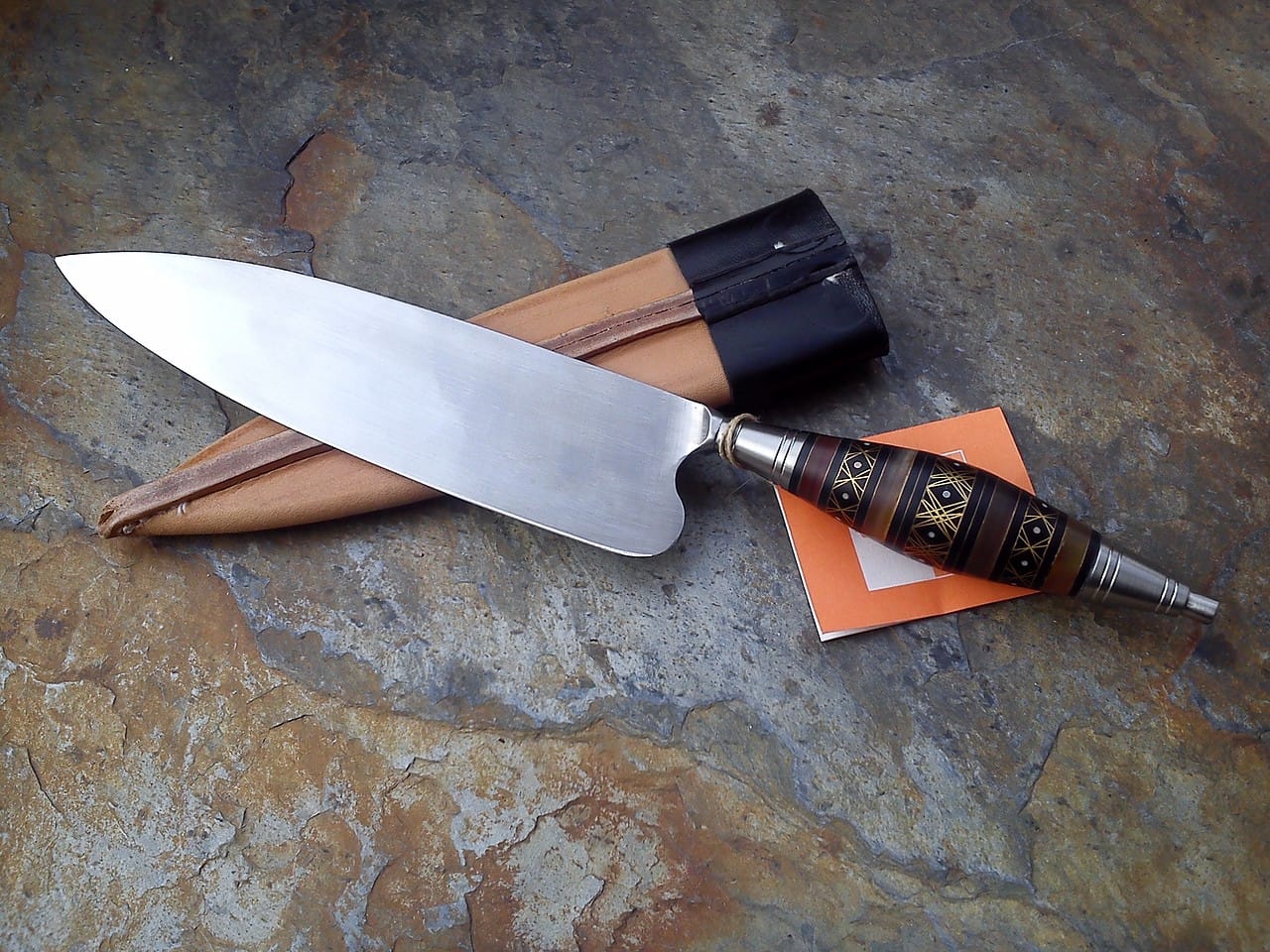
The 'Canarian knife'

The craftsmanship of the Canary Islands has a rich and varied history. However, many times even its own inhabitants do not know it well.
A good example is the 'Canarian knife', a handmade tool from the islands. Unfortunately, today it is at risk of disappearing.
To prevent this, the Cabildo of Gran Canaria has created a documentary about its origin, its history, its evolution, and its different types. It is titled 'The Canarian Knife: From the Workshop to the Gallery'. It has been produced by the FEDAC (Foundation for Ethnography and the Development of Canarian Craftsmanship), which depends on the Cabildo of Gran Canaria.
According to the documentary, the Canarian knife was most likely born in Telde and Santa María de Guía in Gran Canaria. Furthermore, the first clues of its existence date back to the 19th century. Still, its exact origin remains unclear. What is known is that it soon became a basic tool for daily tasks.
With projects like this, the Cabildo of Gran Canaria aims to prevent some of the most typical trades of the islands from falling into oblivion.
Canarian knives are also known as 'farm knives', 'country knives', or 'knives with a handle of pieces'. They were made by the blacksmiths of the islands, who learned the trade as children in the family workshop. Today, however, they are barely used. They are mostly seen at craft fairs or in private collections. Therefore, it is more urgent than ever to conserve this tradition and its history.
How to make a canary knife
The canary knife, also known as «naife» (from English knife), has four parts: the blade, the tang that fits into the handle, the nut that secures it, and the handle, which is its true hallmark. The handle is made from ram, cow, or bull horn, combined with brass, alpaca, silver, or gold, and is decorated with rings and inlaid lines.
The blade is usually made of carbon steel and can be replaced when it wears out, while retaining the same handle. Almost all the work is manual: the horn is heated and shaped by hand with the file, and a machine is only used for sharpening. Depending on the piece, a knife can take anywhere from one day to two weeks of work.
The craft today
There are still artisans keeping the tradition alive, like Francisco Torres, from Santa María de Guía, son of the renowned blacksmith Rafael Torres Osorio. Today, his knives are sold even outside Spain, more as a piece of craftsmanship than as a field tool. If you are interested in the origin of the word «naife», read our article about the origin of the word guagua.