
The cultivation of the vine in La Gomera dates back to the 15th century
Wine tourism, La Gomera
The origins of wine in La Gomera
With the arrival of the conquerors, the new settlers began to bring grapevines from all over Europe. Wine was a food, but it also played an important role in mass.
In 1531, Hermigua was the largest wine production center, with 46% of the entire island's output. Additionally, there were eleven wineries on the nearby beach of Santa Catalina. However, the wine from the island was not sold outside, unlike that from Tenerife. It was used for personal consumption or to make aguardiente. Around the mid-17th century, the sugar cane industry faced a crisis. Since then, grapevines have held significant weight in the island's economy.
Varieties
The islands are far from the mainland and never suffered from the phylloxera plague. As a result, they have preserved a great heritage of vineyards. In La Gomera, the following varieties are cultivated: Listán Blanco, Listán Negro, Marmajuelo, Malvasía Aromática, Pedro Jiménez, Moscatel, Negramoll, Tintilla, Castellana, and Forastera Blanca (or Forastera Gomera).
The White Foreigner is the pearl of La Gomera. It is a white grape very much linked to this island, where it has been for about 500 years. In contrast, most European vineyards are about 150 years old, as they were replanted after the phylloxera.
Its unique character is due to a slow and constant evolution on the island. It produces well and resists pests and diseases very effectively. Additionally, it adapts to high-altitude areas, where it yields wines with good acidity, low pH, and high alcohol content. The best vineyards are located at over 1,000 meters, facing southwest. Wines made with Forastera Blanca account for 90% of the island's wine, and this grape occupies 80% of the vineyard.
Viticulture
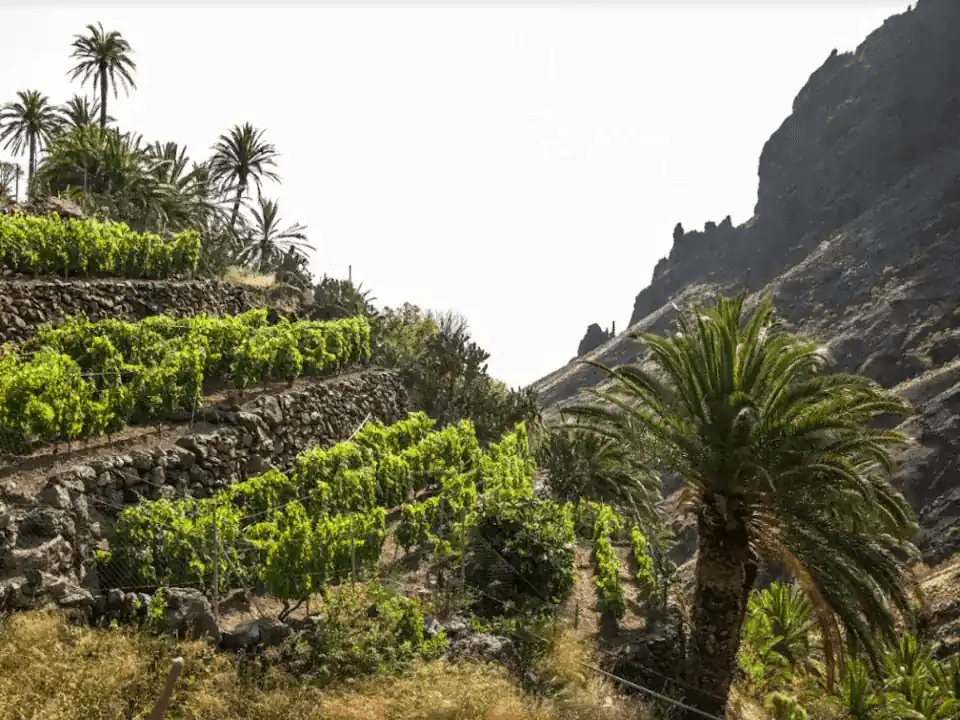
In La Gomera, they speak of 'heroic viticulture.' The vineyards grow on slopes with inclines of 30 to 45%, so cultivation must be done in terraces. Almost all the work is done by hand, and the cost of the grapes is high. Furthermore, many vineyards are in hard-to-access locations.
While walking around the island, you will see pulleys called 'guinches' along the path. They are used to lift grapes from the lower vineyards. The most common system is traditional, with the vine at ground level. In contrast, in Hermigua, a pergola system is used, and in flatter areas, a trellis.
D.O. La Gomera
The Designation of Origin La Gomera was established in 2003 thanks to the Association of Vine Growers and Winemakers of La Gomera. Its aim was to give a boost to the island's wine and organize its production. Today, the Regulatory Council groups more than two hundred vine growers and about twenty wineries. Among its brands are Bodega Insular, Alisios, Niray, Montoro, Altos de Chipude, and Cinco Varas. If you want to see the valleys where these vineyards grow, take a look at our webcams of La Gomera.