
It has always been a symbol.
The Dragon Tree of the Canary Islands
The millenary dragon tree: a natural symbol of the Canary Islands
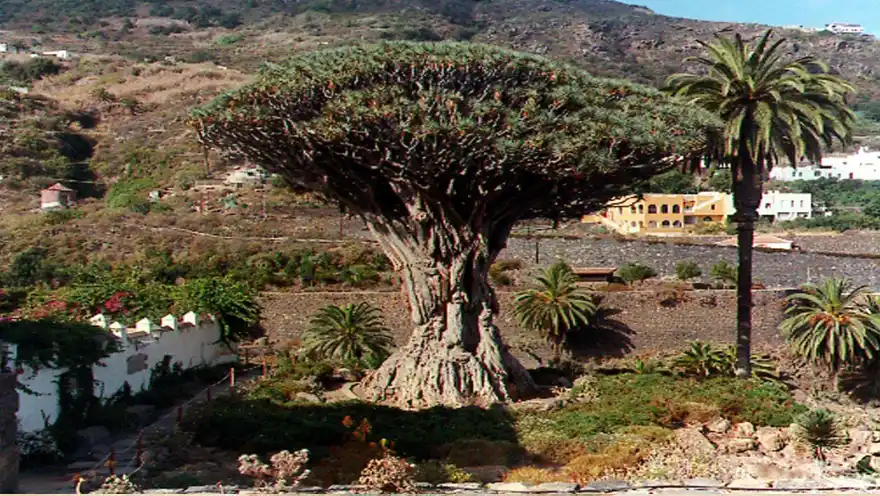
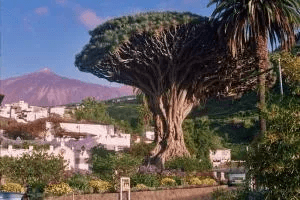
The drago is one of the most well-known trees in the Canary Islands. In addition to its natural value, it holds great significance in the history and culture of the islands. It grows naturally in Tenerife, Gran Canaria, La Palma, La Gomera and El Hierro. Among them, the Drago de Icod, which scientists and artists have admired for centuries, stands out.
In 1799, the naturalist Alexander von Humboldt described the gigantic Drago de Franchy in La Orotava, which disappeared in the 19th century. Later, the painter Marianne North portrayed the drago from the gardens of Sitio Litre, in Puerto de la Cruz. Thanks to these testimonies, the drago became a international symbol of the Canary Islands.
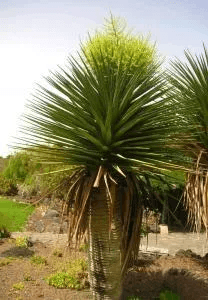
In addition to the Millennium Drago of Icod, there are other notable specimens in Tenerife, in municipalities like Los Realejos, Tacoronte, and La Laguna, as well as in Garafía, on La Palma. In Gran Canaria, meanwhile, resides the Dracaena tamaranae, a drago exclusive to the island. Botanists described it as a new species in the late 20th century.
In 1991, the desire to protect Canary flora led the Canary Government to declare the drago vegetal symbol of Tenerife. This tree has a highly branched trunk, long leaves, and orange-colored fruits. Its red sap, known as "dragon's blood," was used by the ancient inhabitants of the islands as a remedy.

Today, the Millennium Drago of Icod is at the center of a campaign, led by Álvaro Fajardo, that seeks its recognition as a Natural Heritage of Humanity. On the other hand, in 2019, the Humboldt Cultural Association celebrated the 220th anniversary of the naturalist's visit to the Canary Islands.
The Millennium Drago of Icod in numbers
The Millennium Drago is about 20 meters tall, and its trunk has around 20 meters in circumference at the base. Its age is a mystery: although it is called "millennium," the most cited studies estimate it to be between 800 and 1,000 years old, while other estimates go down to just a few centuries. Dragos do not have growth rings like other trees, which is why it is so difficult to determine.
It was declared a National Monument in 1917.
Visit the Drago Park
The drago is located in Drago Park, in Icod de los Vinos, a garden of about three hectares with Canary plants such as cardones and tabaibas, views of Teide, and a cave that was used by the ancient Guanches. Entrance to the park is paid, but the tree can also be seen for free from the square next to San Marcos Church.
Take the opportunity to explore the historic center of Icod, and if the weather is good, head down to San Marcos beach, a small cove with volcanic sand.