

On April 24, 2019, the centenary of the birth of César Manrique was celebrated.
César Manrique: a contemporary of the future
César Manrique Centenary: Art and Legacy on Lanzarote
A visionary of the 20th century
On April 24, 2019, the centenary of the birth of César Manrique (1919-1992) was celebrated. He was a multifaceted artist: painter, sculptor, and architect. He also stood out as a communicator and dedicated his life to his land. His love for Lanzarote extended to the whole Canary Islands.
Lanzarote was the birthplace of this versatile artist, admired worldwide. To commemorate his legacy, the island organized a wide program of events and activities. Among them was a traveling exhibition throughout the archipelago. The tribute remembered Manrique as a communicator, educator, and mentor of his beloved island.
César Manrique's futuristic vision
César Manrique was a visionary who imagined a future that few could conceive. He advocated for a critical view of the territory and tourism development. He also promoted ideas related to responsible tourism and sustainability. These pioneering concepts guided his work until the end of his days.
The Cabildo of Lanzarote promoted the exhibition project "100 years: Lanzarote and César." The exhibition traveled through all the Canary Islands. Its itinerant nature brought the figure of the artist closer to the entire archipelago. It also showcased the evolution of Lanzarote over the last century and encouraged tourism among the islands.
The century of César: Transformation and art in Lanzarote. The change in the 60s and 70s
The exhibition highlights the profound transformation of Lanzarote during the 1960s and 1970s. In those years, the first desalination plant was installed, and the first passenger air connection was inaugurated. These advancements marked a new era for the island.
Lanzarote began to open up to tourism as an economic sector. This change influenced the lives of its inhabitants and the development of the territory. It also transformed the entire archipelago.
The figure of Manrique is essential for understanding this evolution. For this reason, many consider that period as "the century of César." His legacy takes on special importance in a fragile and remote island, marked by a unique landscape and challenging conditions.
A cultural and landscape legacy
Manrique's vision of Lanzarote and the Canary Islands reflects a profound transformation of 20th-century Spain. His work reinterpreted the landscape and created a new way to contemplate it. The artist turned the volcanoes and lava into central elements of the collective imagination.
Art made nature. A unique and respectful aesthetic
Manrique's art sought to move people and bring beauty closer to them. It arose from his love for the land and extraordinary sensitivity. Lanzarote was one of his great sources of inspiration. Its dry, rugged, volcanic, and wild landscape has a special appeal thanks to the light and color.
Traditional architecture is also part of this charm. Byzantine reminiscences, white walls, and green and blue windows stand out. Lanzarote, like the rest of the archipelago, hides treasures that captivate those who visit.
Integration of art and nature
In a few years, Manrique managed to integrate his work into the Canary landscape. His aim was not to modify the territory but to enhance its natural characteristics. To achieve this, he developed a new aesthetic vision he called "art-nature/nature-art."
This philosophy allowed him to combine different artistic expressions with the landscape. Among his projects are viewpoints, gardens, and the recovery of degraded spaces. He also intervened in coastal areas. All these works sought a respectful dialogue with nature.
Emblematic works of César Manrique
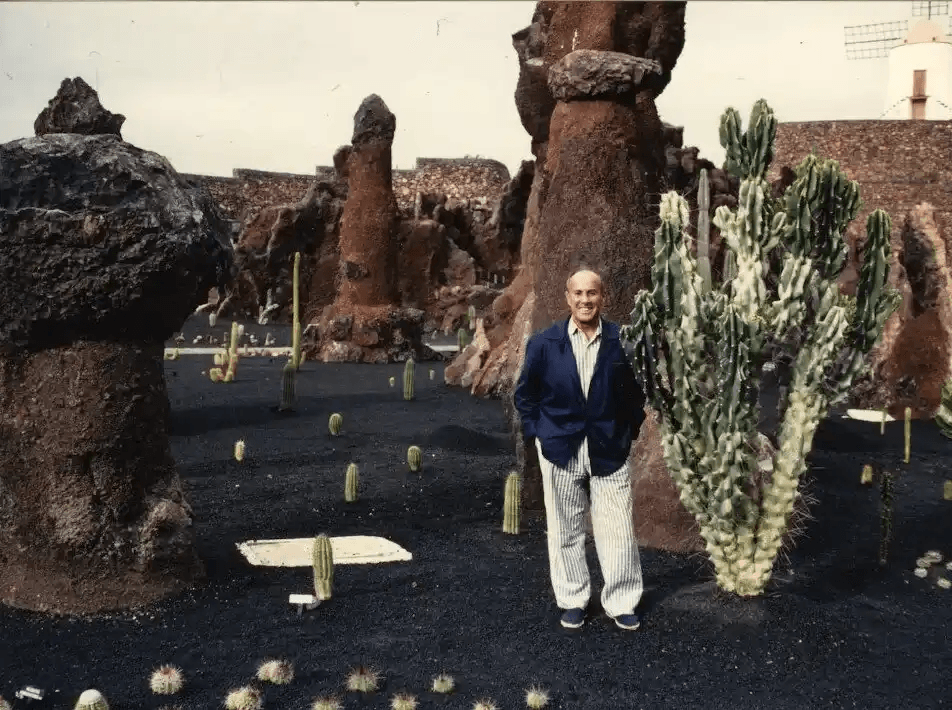
Several of his most famous works stand out in Lanzarote. Among them are the Jameos del Agua, the Mirador del Río, and the Cactus Garden. Also notable is the Taro de Tahíche, his former home and current headquarters of the César Manrique Foundation.
In Tenerife, he left his mark on the Martiánez Lake, in Puerto de la Cruz. He also participated in the development of the Maritime Park, in Santa Cruz. In La Gomera, the Mirador de El Palmarejo stands out. In El Hierro, the Mirador de La Peña is located.
Manrique transformed the way landscapes are contemplated. He also expressed his philosophy with words that reflect his connection to the land:
"Man was not created for this artificiality; there is an imperative need to return to the land, to touch it, to smell it. This is what I feel."