
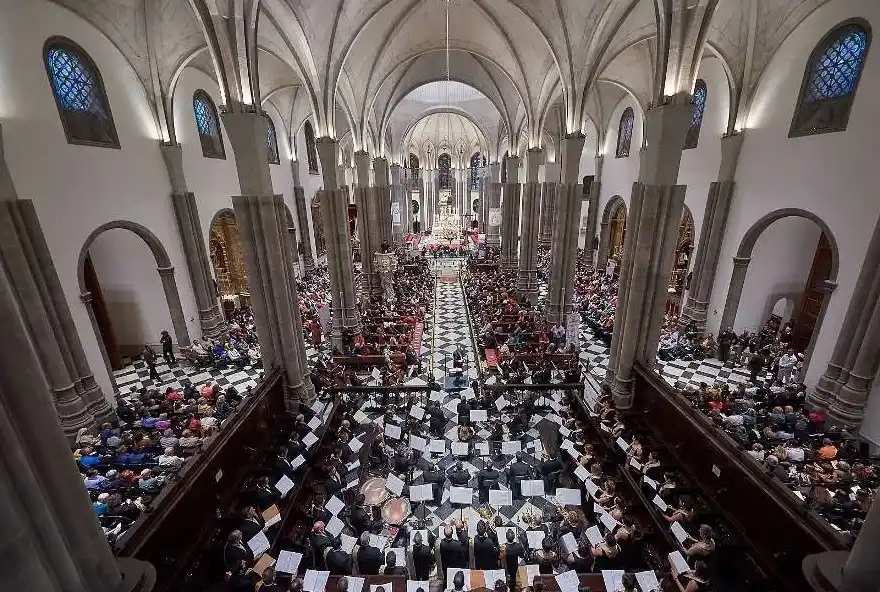
Restoration of the largest altarpiece in the Canary Islands

In June 2021, the restoration of the altarpiece of Our Lady of Remedies was presented at the Cathedral of San Cristóbal de La Laguna. It is the largest altarpiece in the Canary Islands. During the presentation, the meticulous work of the restoration team was highlighted. Thanks to it, La Laguna and the entire island recover a work from the early 18th century of incalculable value.
For his part, the island director of Territorial Planning and Historical Heritage of the Cabildo of Tenerife emphasized the importance of this intervention. Not only is it the largest altarpiece in the Canary Islands, but it is also part of the Cathedral of La Laguna, declared a Cultural Asset of Interest with monument status.
A work from 1715 damaged by time
The altarpiece is the work of local artist Antonio Francisco de Orta, who created it in 1715. It also combines elements of Baroque and Rococo styles.
According to the restorer, its deterioration was due to several causes. First, its changes in location. Second, poorly executed previous restorations. Lastly, the work done in the Cathedral between 2002 and 2014.
How the altarpiece was recovered
The restorer acknowledged that this work has been the 'most important challenge' of her long career. Her main objective was to 'preserve the original work as much as possible.' That is, to maintain its artistic, aesthetic, and historical values, as well as its function.
To achieve this, the team first conducted a physical-chemical analysis and a photographic study. Then, they carefully reconstructed the most damaged pieces, reinforced the structure, and cleaned it. Finally, the phase of polychromy and gilding was reached. Thus, the final result resembles the original work as closely as possible.
You can see the historic center of La Laguna live with our webcam.
The Cathedral of La Laguna, five centuries of history
The altarpiece is located in the Cathedral of Our Lady of Remedies, whose history begins in 1511 with a small hermitage. In 1515, a mudéjar-style church was built in its place, which grew over the centuries to become a cathedral.
Its Neoclassical façade was built in 1820, inspired by that of the cathedral of Pamplona. Between 1904 and 1915, the rest of the temple was reconstructed in Neo-Gothic style, with its characteristic dome.
Twelve years of closed doors
In 2002, the cathedral closed due to serious structural problems. The works, delayed by technical and administrative issues, extended for more than a decade, and the temple did not reopen its doors until January 2014. It was precisely during those years that the altarpiece suffered much of the damage that the 2021 restoration has repaired.
Today the cathedral can be visited and is one of the must-see stops in the historic center of La Laguna, a World Heritage site since 1999.