
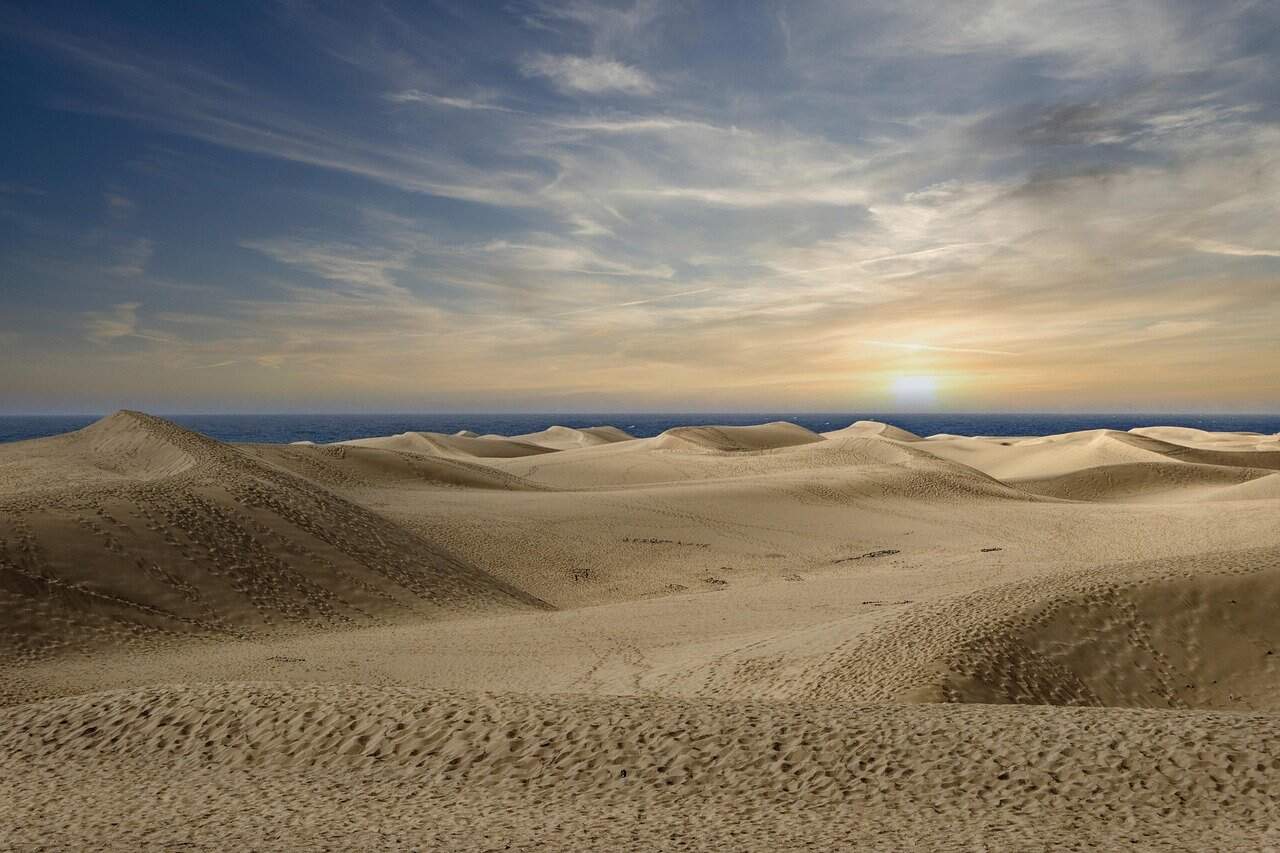
4 magical seasons in a unique destination: Gran Canaria
The best thing about Gran Canaria is that it makes you look at the clock with new eyes. You wake up on the coast with the smell of salt, by mid-morning you feel the fresh humidity of the midlands, at noon the southern sands remind you of an endless summer, and by evening, the air at the summit invites you to close your jacket. In just 50 kilometers, the colors, light, and temperature change completely: it's like experiencing all four seasons in a single day.
Why Gran Canaria has four seasons
The island is almost round and rises to 1,949 meters at Pico de las Nieves. The northeastern trade winds clash against the northern slopes, leaving humidity and clouds there, and arriving dry to the south. Thus, in just a few kilometers, the climate changes completely:
- North (windward): cool, humid, and green, with a sea of clouds caressing the slopes.
- Midlands: mild, with crops, almond trees, and traditional villages.
- Summit: pine forest, cold air, and clear horizons; in some winters, even snow.
- South (leeward): dry, warm, and bright, with dunes, beaches, and calm water coves.
As a general rule, for every 800 meters you ascend, the temperature drops between 5 and 7 °C, and the trade wind clouds can appear in minutes. That's why it's advisable to always carry a warm garment in the car.
An itinerary to experience the four seasons
- Dawn, "spring": walk and coffee in front of the bar at Las Canteras, in Las Palmas de Gran Canaria. Just a t-shirt and a light jacket are enough.
- Mid-morning, "autumn": a short trail through the laurel forest in the north, in Barranco de Azuaje or in Los Tilos de Moya. Bring a thin layer and footwear with good grip.
- Noon, "summer": swim and walk on the Dunes of Maspalomas, with a hat, sunscreen, and water.
- Evening, "winter": viewpoints of Pico de las Nieves or of the Roque Nublo, over the sea of clouds. A windbreaker and thermal layer are essential.
Routes worth a detour
- Green north: Las Palmas de Gran Canaria – Arucas – Firgas – Barranco de Azuaje – Agaete. Historical architecture, banana plantations, and viewpoints of the Atlantic.
- Golden south: Fataga – Degollada de las Yeguas – Maspalomas – Meloneras – Puerto de Mogán. Gorges, dunes, and the shine of the south.
- Volcanic summit: Tejeda – Roque Nublo – Pico de las Nieves – San Mateo. Inland villages and, on clear days, Teide on the horizon.
History: the ancient Canarians and Rome
Although classical authors spoke of the Fortunate Islands, Rome never conquered the Canaries. Archaeology has found punctual Roman presence in the eastern islands, such as the purple dye workshop on the islet of Lobos, off the coast of Fuerteventura, but in Gran Canaria there are no traces of Roman occupation.
Before the arrival of Castile in the 15th century, the island was inhabited by the ancient Canarians of North African origin, who organized themselves into two guanartematos: Gáldar and Telde at the time of the conquest. They built fortified granaries like the Cenobio de Valerón and left places like Risco Caído, a World Heritage site since 2019, and the Cueva Pintada of Gáldar.
Heritage and flavors
In Las Palmas de Gran Canaria, the Canarian Museum explains pre-Hispanic life, and the Vegueta neighborhood, with the Casa de Colón and the Cathedral of Santa Ana, tells the story of a city open to the Atlantic. In Guayadeque, the cave-houses and hermitages carved in the rock connect the present with ancestral ways of living.
On the table, the Guía flower cheese, the bienmesabe of Tejeda, the wrinkled potatoes with mojo, or the wines from the Gran Canaria Denomination of Origin complete the experience.
Nature for all rhythms
- Hiking: Roque Nublo, Tamadaba, or Pilancones, among pines and volcanic rocks.
- Wind sports: Pozo Izquierdo and Vargas beach are world-renowned.
- Urban beach: Las Canteras, with its natural break, is perfect for snorkeling and surfing.
- Protected spaces: nearly half of the island is protected, and a large part of it has been a Biosphere Reserve since 2005.
Gran Canaria live
The weather changes, and anyone who has had to adapt their plans on the go knows that. With our webcams of Gran Canaria you can check the state of the sea at Las Canteras, the light at Maspalomas, the sea of clouds in Tejeda, or the wind in Pozo Izquierdo before you go out.