
Discover the fascinating vineyards of Lanzarote
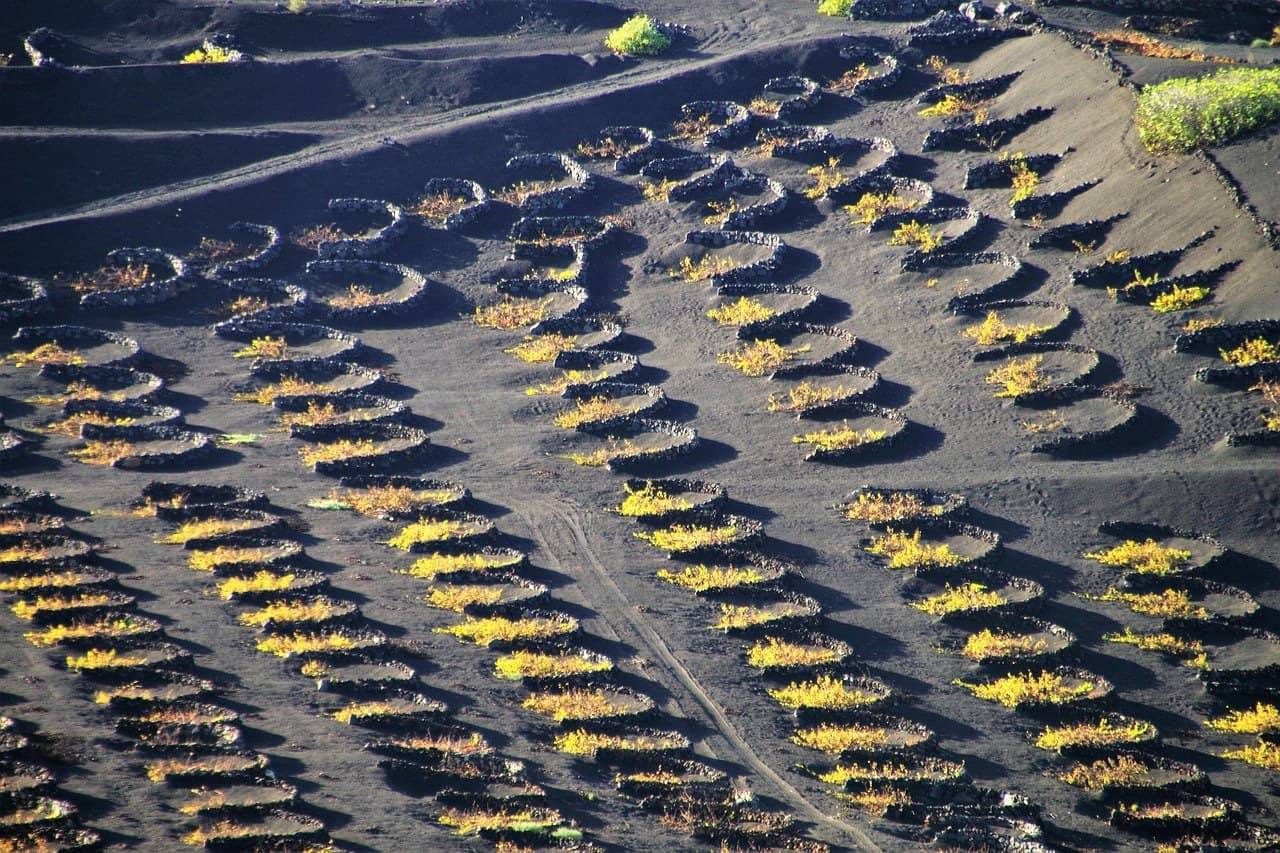
The first time one peeks into La Geria, the landscape defies logic. Over an ocean of black ash, hundreds of perfect craters emerge, each with a vine at the bottom and a wall of volcanic stone embracing it. There are no rivers, it barely rains, and the wind blows almost daily. And yet, the green of the leaves shines. The secret lies beneath our feet.
How life sprouts in a lava desert
After the Timanfaya eruptions from 1730 to 1736, the inhabitants of Lanzarote learned that volcanic ash, picón, could be tamed. It was enough to dig down to reach the fertile soil that had been buried. This gave birth to sandy cultivation: holes 2 to 3 meters in diameter and depth, at the bottom of which the vine is planted and then covered again with a calibrated layer of lapilli. At the edge, a semi-circle of dry stone forms a zoco that brakes the wind and prevents the ash from refilling the hole.
From a distance, that repetition of holes and semi-circles looks like a lunar mosaic. Up close, it is popular engineering applied to precision botany.
Picón is much more than ash. It acts as both shield and sponge:
- It captures the nightly dew and gradually leads it to the fertile soil.
- It reduces direct evaporation of water, like a natural mulch.
- It stabilizes the soil temperature. Its dark color absorbs heat during the day and releases it at night.
- It facilitates the infrequent rains to filter quickly without flooding.
The zoco, for its part, is a defense against the trade winds that sweep the island. At just half a meter high, its curved stone is sufficient to create a calm eddy at plant level.
Techniques born from necessity
The classic sandy cultivation of La Geria was not the only response. Where ash didn't cover such a large area, artificial sandy cultivations were devised, spreading picón and manure to replicate the system. In the rough malpaís of La Corona, chabocos and trenches were opened, breaking lava flows to expose ancient soil and shelter it with stone walls.
Each technique pursues the same goal: to conserve moisture, slow the wind, temper the soil. In all of them, human labor prevails, as mechanization in these soils is almost impossible.
Practical table of traditional systems
| Technique | Usual location | How it is constructed | Key advantages | Main challenges |
|---|---|---|---|---|
| Sandy cultivation of La Geria | La Geria | Hole of 2–3 m, vine at the bottom, layer of picón and semi-circular zoco | Retained moisture, protection against trade winds | Manual work, labor-intensive |
| Artificial sandy cultivation | Areas outside of La Geria | Addition of picón and organic matter over conventional soils | Replicates the benefits of picón in other locations | Cost of picón, logistics, and maintenance |
| Chabocos and trenches | Malpaís of La Corona | Opening cracks in lava, exposing soil, protective walls | Savings on picón, good wind shelter | Rock hardness, low yield |
Minerals, alkalinity, and well-managed thirst
Lanzarote receives less than 200 mm of rain per year. Even so, the vine does not suffer from thirst when planted properly. Under the blanket of lapilli, the ancient basalt soils are rich in minerals and have an alkaline pH due to free carbonates. There is enough nitrogen and nutrients for a hardy plant like the vine, and the picón acts as a thermal and moisture regulator. This "binomial" soil-picón creates a unique microenvironment: tempered roots, available moisture for longer hours, and just the right stress to concentrate aromas without punishing acidity.
The grapes that best express this landscape
The Denomination of Origin Lanzarote has protected and prioritized local varieties that are well-suited to this territory.
- Whites: Malvasía Volcánica, Moscatel de Alejandría, Vijariego (Diego), Albillo, Gual, Verdello.
- Reds: Listán Negro (Almuñeco), Negramoll (Mulata), Malvasía Rosada, Tintilla.
The queen is the Malvasía Volcánica. It only exists here, and its name is not coincidental. It adapts astonishingly well to the black soil and the wind. Its wines are usually fragrant, with white fruit, flowers, and a mineral echo reminiscent of sea salt. Reds, on the other hand, tend towards medium color and gentle tannins, with a spicy or herbaceous note and fresh acidity.
Common styles on the island
- Dry and semi-dry Malvasía Volcánica.
- Sweet and semi-sweet Malvasía and Moscatel.
- Young reds from Listán Negro and Negramoll.
- Some sparkling wine made using traditional methods with a white base.
Zocos: minimal architecture, maximum efficiency
Each zoco is a climatic capsule. The volcanic stone is laid dry, piece by piece, leaving a crescent that reduces the speed of the air at ground level. The wall stops the sand, the trench protects the trunk, and the layer of picón filters and retains moisture. This design allows a single plant to thrive where nothing else would grow.
Looking at a row of zocos is like reading the wind in stone. And understanding how the local culture turned an adverse land into a living vineyard.
Why these wines have gone unnoticed for so long
History helps explain it. Before the 18th century, there was no established viticulture. Eruptions forced the invention of a new manual method. For generations, the land was in the hands of large absent landowners and worked under harsh conditions, with mediocrity and little incentive. Many families emigrated. The land that remained was sustained through perseverance.
When the system settled, other barriers appeared: low yield, high costs, little mechanization. Producing a hectare of sandy soil, managed by the local wineries, requires investment and manpower. The wines were expensive to compete in mass markets. They were sold locally, consumed at home. Over time, European aid promoted the maintenance of the landscape, a cultural and environmental goal as much as an agricultural one.
What is produced, what travels, and what is still left to open
Today, the DO has just over one million liters annually. Approximately half goes outside the islands, with destinations including Germany, the United States, or Japan. It sounds good, and it is within the Canary context. On a global scale, it remains a drop in the bucket. That's why it still has an aura of rarity: there is no volume, but there is personality.
In the market, the Malvasía Volcánica concentrates a large part of the production. This concentration helps build a clear identity, easily recognizable by sommeliers and specialized stores.
Awards that make noise beyond the Atlantic
The fine work in the field and winery is increasingly reflected in international competitions. Historic wineries and young projects have won medals in high-prestige contests. At the 2022 Decanter World Wine Awards, for example, El Grifo reached gold and silver medals that put Lanzarote on the map for many professionals. Recent years have brought new awards in Croatia, Portugal, and Spain, from golds to Great Golds, with labels of Malvasía Volcánica, Listán Negro, and Moscatel now appearing on specialists' shopping lists.
The echo of those awards is twofold: prestige for the winner and curiosity for those who have yet to try a volcanic white from the island.
Tourism as a springboard and as a commitment
Lanzarote is breaking visitor records, and places like Tinajo and La Geria have become must-stop locations. Tastings at sunset, walks through the vineyards, popular grape harvests, wine museums. The territory is interpreted, explained, and, above all, tasted. This direct contact has boosted sales in wineries and generated a clear awareness: preserving the landscape is also a way to care for the local economy.
The harmony between institutions, wineries, and tourism companies is strengthened by technical initiatives aimed at sustainability. The goal is to maintain the artisanal character while reducing footprints and consumption. In practice, each bottle sold on the island contributes to the maintenance of those walls, those pits, that black and green mosaic.
Microclimate that shapes the bunch
The climate of Lanzarote is mild in average temperatures but extreme due to wind and dryness. The usual range is between 16 and 25 ºC, with the marine influence softening the peaks. There are days of calima that raise the thermometer above 30 ºC and dry the air. In that environment, the picón mitigates, the vineyard protects, and the plant learns. The ripening is prolonged enough to retain acidity, while the sun ensures pure and clean fruit.
Result in the bunch: berries with healthy skins, high aromatic content, and clear acidity. Result in the glass: vibrant whites and light reds with a firm presence.
Advantages and challenges of cultivating on ash
What the vine grower gains:
- Less competition from weeds due to the barrier effect of the picón.
- Temperate soil and roots with useful moisture for a longer period.
- Harvests that reflect a unique landscape, easily identifiable.
What the vine grower pays:
- Labor-intensive work in all operations.
- Excavation and maintenance of costly vineyards.
- Yields contained by regulation and by nature of the system.
The equation is clear: limited production, differential quality. Whoever opens the bottle pays for human labor, a system that makes a virtue of water scarcity, and the care to produce high-quality wines, a critical resource on the island.
What do the wines of Lanzarote taste like?
Dry Volcanic Malvasía usually offers high and defined aromas: white flower, pear, apricot, citrus. On the palate, acidity dominates, a texture reminiscent of fine salt and a clean finish. In semi-sweet and sweet versions, the aromas become honeyed, with honey, candied fruit, and a herbal background.
Listán Negro and Negramoll produce ruby-red wines, with friendly tannins, hints of pepper, bay leaf, and wet lava. They are versatile and appreciate a light aging in wood or inert deposits that respect their fruit.
Service and pairing suggestions
- Cold dry Malvasía with grilled limpets or rock fish.
- Sweet Muscatel with cured goat cheeses and almond desserts.
- Young Listán Negro red with roasted black pig or marinated kid.
- Semi-sweet Malvasía with spicy Asian cuisine, a delicious contrast.
Guidelines for styles and dishes
| Wine style | Dominant grape | Sensory profile | Recommended island dish |
|---|---|---|---|
| Dry white | Volcanic Malvasía | Floral and fruity, high acidity, mineral background | Grilled sargo, green mojo |
| Semi-sweet white | Malvasía/Muscatel | Ripe fruit, balanced sweetness, citrus touch | Semi-cured majorero cheese |
| Natural sweet | Muscatel/Malvasía | Honey, dried apricots, orange blossom, long finish | Bienmesabe, sweet potato trout |
| Young red | Listán Negro | Red fruit, mild spice, light tannin | Goat meat, wrinkled potatoes |
| Moderately aged red | Negramoll/Tintilla | More structure, balsamic, mineral | Gentle seasonal stews |
Tips for a rewarding visit
- Reserve tastings and visits in advance, especially in high season.
- Stick to marked paths. Do not climb on zocos or walls.
- If you can, buy at the winery. This directly supports the maintenance of the landscape.
- Avoid taking 'souvenirs' of picón. This black mantle is a vital part of the system.
- Attend an early harvest. In Lanzarote, it usually occurs earlier than on the mainland.
An open-air sustainability laboratory
The Lanzarote paradox is inspiring: viticulture without rivers, in poor soils, with constant wind and vineyards that defy extreme conditions. The island's technical response has more than two centuries and today is viewed through the lens of sustainability. The water savings guaranteed by picón, the natural limitation of yields, the manual skill. Everything fits with an approach to a living landscape that is cared for through accumulated knowledge and conscious decisions.
Anyone seeking wines with a sense of place has here a case study. The glass does not taste the same because the soil is not the same, because the climate does not express itself the same way, and because the local culture has designed its own method.
As evening falls, when the low sun paints the ash plains red and the walls cast perfect semicircular shadows, a salty breeze sweeps through Geria. In the treetops, the Malvasía smells of fresh fruit and the nearby sea. It’s easy to toast with the feeling that this sip holds the heartbeat of an island that learned to cultivate lava. And it turned it into wine.