

Social and economic relations between the Canary Islands and the United Kingdom
From William Shakespeare to Isaac Newton
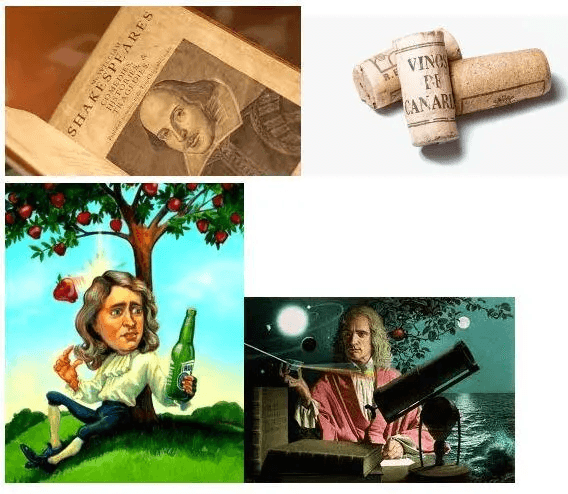
Relations between the Canary Islands and the United Kingdom: history and wines
The relationships between the Canary Islands and the United Kingdom are not only based on modern tourism but also on centuries of commercial exchange. One of the most important products was Canary wine, especially appreciated in England during the 16th and 17th centuries.
Canary wine in English literature
William Shakespeare mentioned Canary wine in his works. In Henry IV (second part), the landlady Mistress Quickly reproaches Doll Tearsheet for drinking too much "canaries", a wine that, according to her, "perfumes the blood". Falstaff, a great fan of sack, orders Canarian wine in The Merry Wives of Windsor, and Canarian wine also appears in Twelfth Night. Shakespeare never wrote the word "malmsey", but historians believe that this canary was the malmsey that the islands exported to England.
Isaac Newton and the wine from the Canary Islands. Trade between the Canary Islands and Great Britain
According to a very repeated anecdote, Isaac Newton also appreciated Canarian wine, although we have not found solid documentation to confirm it. What is well documented is that, during the 16th and 17th centuries, Canarian wine was one of the most prized in England, and its trade connected the islands with British ports.
Curiosities about Isaac Newton
Newton was a character full of curiosities: besides his scientific discoveries, he spent years on alchemy and even inserted a needle next to his eye to study the perception of light. But that is another story.
The Canary Company and the 'wine spill'
The Canary wine trade with England faced its major crisis in the 17th century. In March 1665, King Charles II granted the Canary Company, formed by merchants from London, the monopoly on Canary wine trade with England. Their agents set the prices, and many winemakers in Tenerife were left ruined.
In July 1666, in Garachico, hundreds of locals stormed the wineries and broke the barrels intended for the company: the wine flowed through the streets rather than being sold at ruinous prices. This episode is known as the 'wine spill.'
The end of the monopoly
London's response was to prohibit the entry of Canary wines into England, but the company also faced its own problems: the great plague of 1665, the Great Fire of London in 1666, and pressure from independent merchants. In September 1667, Charles II revoked its privilege, and the Canary Company dissolved.
Today Garachico, with its historic center and natural pools, is one of the prettiest towns in Tenerife: you can see it live with our webcams of Garachico.