
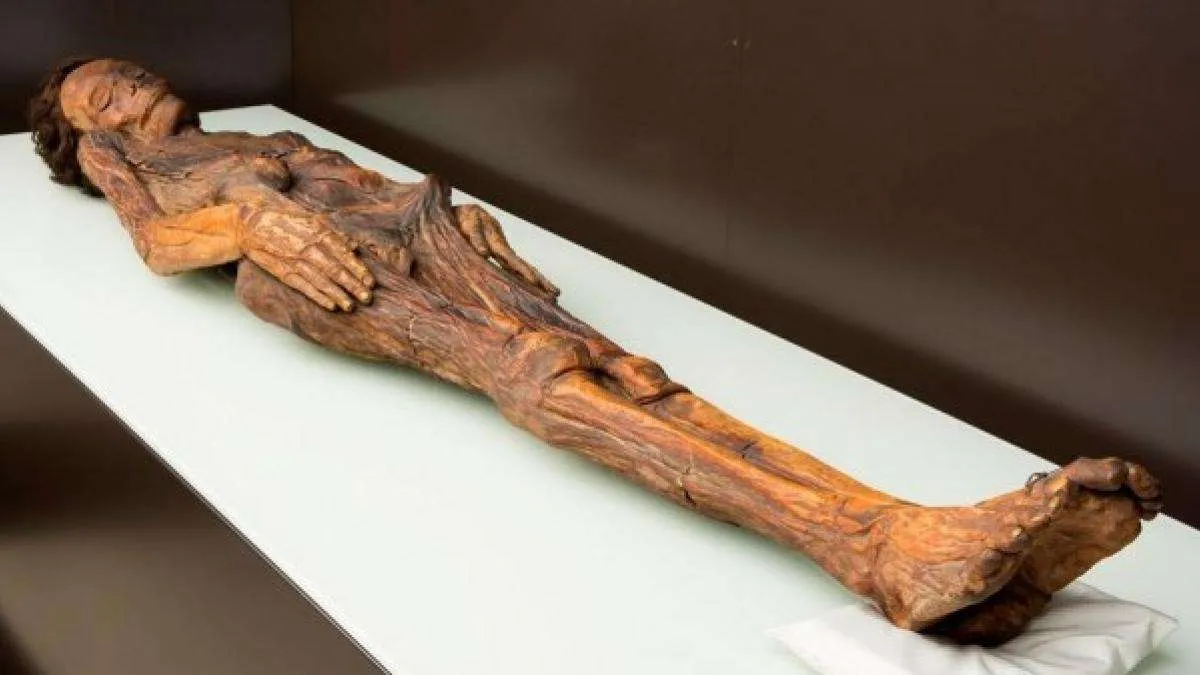
The best-preserved Guanche mummy
The best-preserved Guanche mummy reveals its antiquity
The remains better preserved is one of the most important archaeological finds in the Canary Islands. Displayed since 2015 in the Canary Room of the National Archaeological Museum (MAN), this piece has undergone scientific studies that have revealed fascinating details about its origin and the conservation process used by the ancient inhabitants of the islands.
Origin and discovery of the best-preserved Guanche mummy
The best-preserved Canarian mummy was found in a cave in the Herques ravine in Tenerife in 1763. Shortly thereafter, it was taken to the court of Carlos III with the aim of showcasing the unique skill of the Guanches in the preservation of corpses to the Spanish public.
Throughout its history, this body has been present in various cultural and scientific institutions:
- House of Governor Francisco Javier Machado (1764)
- Museum of Antiquities of the Royal Library (1766)
- Royal Cabinet of Natural History (1771)
- National Anthropology Museum (1910)
- National Archaeological Museum (since 2015)
It was even exhibited at the 1878 Universal Exposition in Paris.
Carbon-14 dating in Guanche mummies
One of the most recent advancements in the study of the best-preserved Guanche mummy is its dating through the carbon-14 method. This analysis was conducted at the National Accelerators Center in Seville, using two samples taken from shoulder tissue.
The results indicate that the man passed away between the years 1154 and 1260 A.D., placing his age at approximately 850 years , with a margin of error of around 30 years.
This dating confirms that it is not the oldest found to date — that honor goes to a mummy from the Barranco del Infierno, dated at 1,665 years — but it does stand out for its exceptional state of preservation.

Why is the Herques mummy special?
Beyond its age, what makes the Herques mummy unique is its perfect physical condition compared to other Guanche bodies found in the same cave. According to historical records, when it arrived in Madrid in 1763, it already attracted attention for its almost intact appearance.
Recent studies have revealed that:
- He was an adult man between 35 and 40 years old
- He measured 1.62 meters
- He had a complete dentition and no cavities
- He showed Negroid features
- His hands showed no signs of heavy labor
All this suggests that he held a privileged social position within his community.
The mystery of mirlado: Guanche conservation technique
The process used by the Guanches to preserve bodies was known as "mirlado" . This term describes a sophisticated embalming practice that allowed the preservation of thousands of bodies for centuries.
In the case of the best-preserved Guanche mummy , the computed tomography revealed that the entrails and brain were not removed, something that contradicts some Castilian historical chronicles.
This raises new questions about whether the Guanches used techniques different from those described or if they adapted their methods according to the status of the deceased individual. In fact, this finding opens new lines of investigation into how evolved the process of preserving ancient corpses in the Canary Islands.
Conclusion
The best-preserved Guanche mummy is not only a unique testament to the aboriginal culture of the Canary Islands but also an example of how science helps to unravel the secrets of the past. Thanks to the study of its antiquity through carbon-14 dating , we now know more about who this man was and how he lived over 800 years ago.
This type of research continues to be key to understanding the history of pre-Hispanic peoples and their relationship with the natural and cultural environment.