
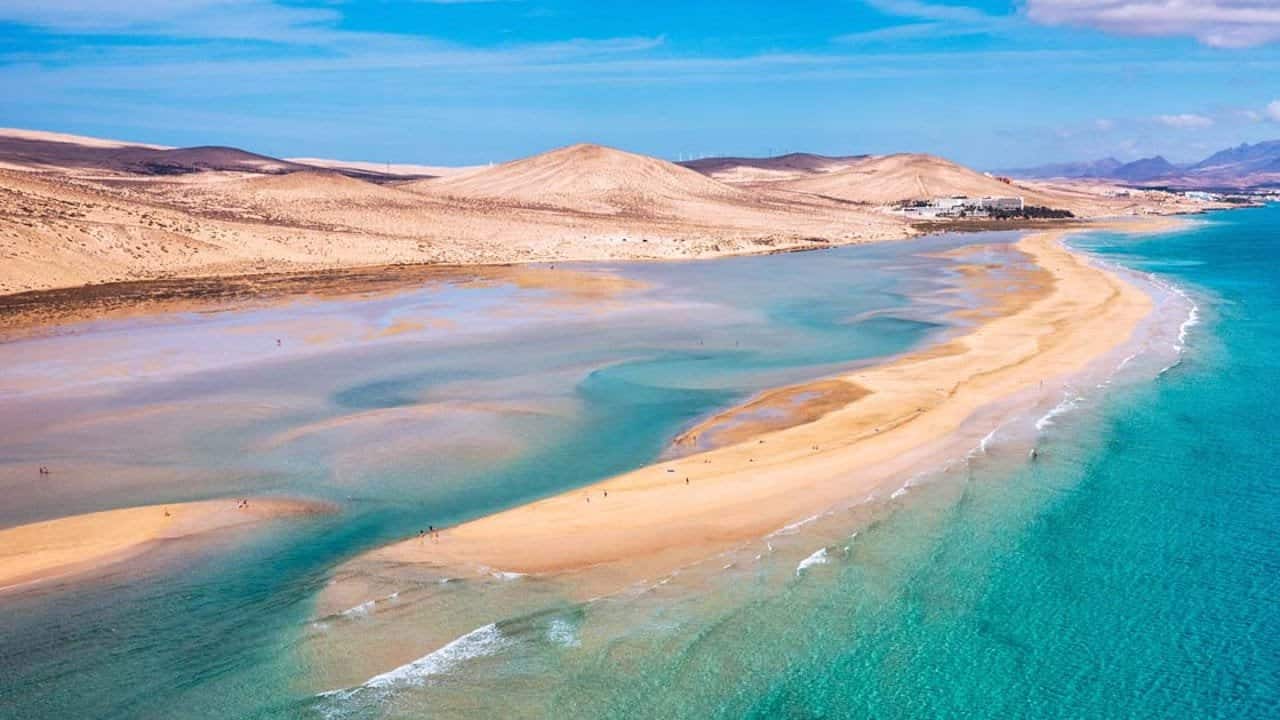
Fuerteventura and its colors: landscapes that transform the soul
The first time one steps Fuerteventura it feels like color has turned up the volume. Light takes over everything and, in that almost lunar setting, sand, rock, and ocean compose a mosaic that changes every hour. From the blinding whites to the volcanic blacks that swallow the gaze, the island is a chromatic geography that moves with the sun, the trade winds, and the pulse of the Atlantic. Those who come for the surf stay for the light. Those who come for the light discover that the landscape also resonates with long left turns and golden foam at sunset.
Volcanic palette in high fidelity
The secret of this intensity starts beneath the feet. Fuerteventura, part of the Canary Islands, is an ancient volcanic island where erosion has sculpted gentle reliefs in soils poor in organic matter and constantly exposed to the sun. The result is a catalog of sands and rocks rarely hidden by dense vegetation. Everything is visible, as if the territory decided to reveal every layer.
- Bright coral sands in the north, shaped by broken shells and the action of fish that grind coral. The brightness in Corralejo El Cotillo is almost laboratory-like.
- Golden dunes of crushed shell that the wind moves and combs, painting the horizon warm yellow.
- Beaches of black volcanic sand in enclaves like Ajuy, where the basalt contrasts with an almost emerald sea.
- Brown and ochre hues resulting from local erosion and ashes that ignited slopes, with shades brushing against pink or violet on certain slopes.
The lava flows retain a deep, matte black that breaks the beige of the sandy areas. In between, gray and reddish deposits reveal ash episodes. This picture of scorched earth and lively sands never dims because the vegetation is low, xerophytic, and allows the soils to breathe color.
One detail that fascinates the curious observer: the absence of humus prevents naturally dark soils from forming. Hence, ochres, toasted browns, and reddish tones dominate. And when the sun hits them at a low angle, they seem to ignite from within.
Light, a patient painter
For an island, light is not an accessory. It is the author. Fuerteventura accumulates nearly 2,800 hours of sunshine a year, receives little rain, and has almost no mountains capable of squeezing the clouds. The atmosphere remains clean and transparent most of the time, with a clarity that accentuates every transition of color between sand, rock, and water.
The sea responds with its own scale: photographic turquoise in shallow bottoms, cobalt blue in the quick cuts to depth, and a horizon line so sharp it seems drawn with a ruler. At noon, the contrast spikes and saturation is at its peak. In the morning and afternoon, the warm light envelops and softens, and the elongated shadows cool the valleys into faint blues.
Not everything is stable. The haze coming from the Sahara introduces particles that filter blues and enhance oranges and reds, multiplying effects at dawn and dusk. High clouds, when they appear, act as a diffuser and turn a harsh midday into a canvas of flatter tones, useful for detail photography.
How the island dresses at each hour
| Daytime strip | Type of light and angle | What happens to colors |
|---|---|---|
| Dawn | Soft, warm, grazing light | The sands turn to pale gold, the ravines fill with blue shadows, and the lava acquires coppery glints. With haze, the solar disk appears intense red. |
| Noon | White and hard light, vertical | Maximum saturation: turquoise turns electric, the white of the sand dazzles, shadows contract, and basalt appears more uniform. |
| Sunset | Golden light, horizontal | The entire landscape turns amber. The sand acts as a luminous carpet, the orange sky embraces the sea, and the volcanic rock reflects reddish glimmers. |
The chameleon island that changes with steps
The same beach seems different depending on the viewpoint, especially when viewed from vantage points. In El Cotillo, a few meters' turn is enough to switch from natural pools with a milky bottom to black rock inlets that cut the waves into perfect triangles. On the gentle slopes of the interior, one ridge may shine while the adjacent one remains cool and blue in shadow, creating an alternation that entices the photographer.
On mountains like Tindaya or on the dormant cones of La Oliva, the low sun traces veins on the flanks, reveals the grain size, and unveils a range of reds, pinks, and ochres that only appear during the fine hour of the day. The eye quickly gets accustomed to looking for the angle, reading the mineral, and anticipating how light will transform it.
The turquoise sea that calls to surf
The other side of color is movement. The Atlantic beats against the northern coast with constant swells, and the northeast brings tradewinds that, between May and August, blow with determination. The water rarely drops below 18 degrees in winter and hovers around 23 in summer, a pleasant range that keeps the community active all year. It’s no accident that the island has been compared to a European Hawaii by pioneers who decided to stay.
The lava bottoms turn certain breaks into precision clocks. When the tide, wind, and period align, lefts and rights appear that teach the way. In other stretches, the sand takes command and softens the profile, ideal for learning. Additionally, the wind gifts a shallow lagoon in Sotavento perfect for windsurfing and kitesurfing, with international events that repeat course after course.
Five scenarios, five shades of wave
| Spot | Type of wave and bottom | Recommended level | What to expect and when |
|---|---|---|---|
| Rocky Point, Corralejo | Left point on volcanic rock | Intermediate | Gentle and long wave, very educational for maneuvers. Works with north swells and mid tide. Schools and rentals at street level. |
| El Cotillo, northwest | Several peaks on sand and rock | Intermediate to advanced | Annual consistency, powerful when long beach swells come in. After the session, white coves to lower heart rates. |
| Majanicho | Technical left on reef | Advanced | Access by track and wild environment. Requires fine reading of tide and wind. Few people, no concessions. |
| Esquinzo and La Pared, Jandía | Beach break with sand and some rocks | Beginner to intermediate | Suitable for starting with instructors. The corner of Esquinzo protects from the wind on certain days. |
| Costa Calma and Sotavento | Wind waves and lagoon | Beginner in wind and kite | Long right waves with wind, calm waters at the right tide, schools in front of the beach. |
Those who come to surf learn to read not only the report but also the color. The navy blue warns of depth and deception, the turquoise reveals moving banks that change the section of the wave, the glints on the lava confirm whether there will be grip or slip. Light is not just a decoration: it informs.
Golden sunsets that are remembered for years
There are islands with beautiful sunsets and places where the sunset seems like a craft. Fuerteventura belongs to the latter. The combination of clean air, an open horizon to the west, and naturally pigmented soils creates beautiful sunset scenes that are hard to forget.
- In El Cotillo, the shallow reefs return a warm glow that tints lagoons and shores. The white sand acts as a spotlight from below, amplifying the golden hour.
- La Pared, further south, offers a natural stadium to watch how the sun falls just into the ocean. The tone here tends to deep amber, with foam glowing as it breaks.
- Cofete is another league. The volcanic backdrop, the colossal beach, and the absence of anything human make every color seem purer. There is no better filter than the silence of the place.
- Ajuy, with its black cliffs, offers a contrast that borders on dramatic when the sky turns fiery orange.
Those who understand physics will say that Rayleigh scattering plays its part. Fine particles reduce blues as the sun goes down, hence the predominance of oranges and reds. Those who don't need formulas come with time, sit down, and watch in silence.
Simple tips to capture that light:
- Check the forecast. Clear skies or those with high veils usually work well. With haze, the spectacle gains in reds.
- Avoid screens and let the eye adapt; the first minutes are deceiving, the next reveal nuances.
- Wear a light garment for the wind. The thermal sensation drops quickly when the sun touches the water.
- In photography, use a polarizer carefully at noon and remove it at sunset to avoid stealing the shine from the gold of the sky.
Green that peeks out, green that stands out
The vegetation in Fuerteventura does not compete with the soil's nature; it highlights it. Spiny aulagas in brownish-green tones, succulents, and small cacti are spread across slopes and malpaís, with matte greens resting the eyes against so much ochre. Here and there appears some dragon tree juvenile, with a gray trunk and compact crown, clinging to a damp crevice that only it knows how to find.
In generous years, winter brings a blooming desert that tinges some plains green. It doesn't last long and never covers everything, just enough for the contrast with the volcanic reds to be even more evident. It's a chromatic breath, a pause that makes the landscape appear even cleaner when summer returns.
Where each color is born
A good way to read the island is to associate places with tones. A quick guide, useful for a first visit and for those seeking scenes:
- Corralejo and its dunes: yellows and creams that ignite with the low sun. Ideal at dawn when the nocturnal wind has drawn the crests.
- El Cotillo: whites of coral sand, calm turquoises at mid-tide, and blacks of rock that warm up at dusk.
- Ajuy: absolute blacks on cliffs and caves, white foam that cuts like chalk, changing sea between green and deep blue.
- Betancuria and the interior: ochres, browns, and some mineral pink. It improves in the last light, with long shadows that shape the hills.
- Jandía: complete ranges, from vast beaches to eroded lavas, with open skies for frontal sunsets.
For those who ask for something more systematic, here’s a minimum mental map:
| Element | Dominant tone | Why it happens | Where to look at it |
|---|---|---|---|
| Shell sand | White, cream, golden | Crushed shells and coral, light grains that reflect a lot of light | Corralejo dunes, El Cotillo coves |
| Basaltic lava | Black, very dark gray | Volcanic flow rich in iron and magnesium, vitreous surface | Ajuy, malpaíses of the north |
| Ashes and volcanic soils | Ochre, red, pink, light violet | Oxidation of minerals and absence of humus | Interior of La Oliva, Betancuria |
| Shallow water | Turquoise, aqua green | Light bottom and little depth filtering into high blues | El Cotillo lagoons, Sotavento |
| Deep water | Intense blue | Column of greater water and absorption of long wavelengths | Open coast to the north and west |
Suggestions for experiencing the palette in an active way
The island invites movement, to explore its unique tourism, and to look around. A plan combining action and color can follow this rhythm:
- Wake up early in Corralejo to see how the first gold runs across the dunes and, if the forecast allows, enter the water at Rocky Point with soft light and little wind.
- Jump inland mid-morning, when the sun accentuates the ochres without flattening them, and crown a viewpoint near Betancuria to see the gradation of valleys.
- Midday visual rest in a cove at El Cotillo with a hat and shadow, as the white here is overwhelming and the turquoise calls for calm.
- Afternoon with a breeze on the southern coast, watching how the wind paints the surface of Sotavento and turns the water into a mosaic of blues.
- Last light at La Pared or Ajuy to witness the golden hour in all its vigor. Repeat the next day, because no two are the same.
Small practical notes:
- Polarized sunglasses and high sun protection are part of the kit just like the towel or board.
- On roads to remote spots, a 4×4 and respect for signage avoid disappointments. The fauna and flora are closer than they seem.
- On days of intense dust, hydrate well and value interior views where dust softens the maritime horizon.
Color culture, sea culture
Fuerteventura not only showcases colors, it brings them to everyday life. The surfing community has woven together schools, workshops, shops, and events that invigorate towns like Corralejo and Lajares. Many newcomers stay because the routine here is complemented by the sun, the wind, and that feeling of having the ocean right next to home. One learns to measure the day by the angle of light, to recognize when the sand is whiter and the water clearer, to sense whether the sunset will call for a short walk or a long contemplation.
There are days when the north roars, the foam takes on golden hues, and the sky appears as a freshly painted canvas. Other days, the interior is silent, and only the wind can be heard, while colors remain close to the earth. Those who leave carry in their memory the impossible turquoise of a shallow shore and the fiery line of the sun sinking into the Atlantic. Those who return do so because, in some way, they feel that they lack that dose of light that can only be found here.