
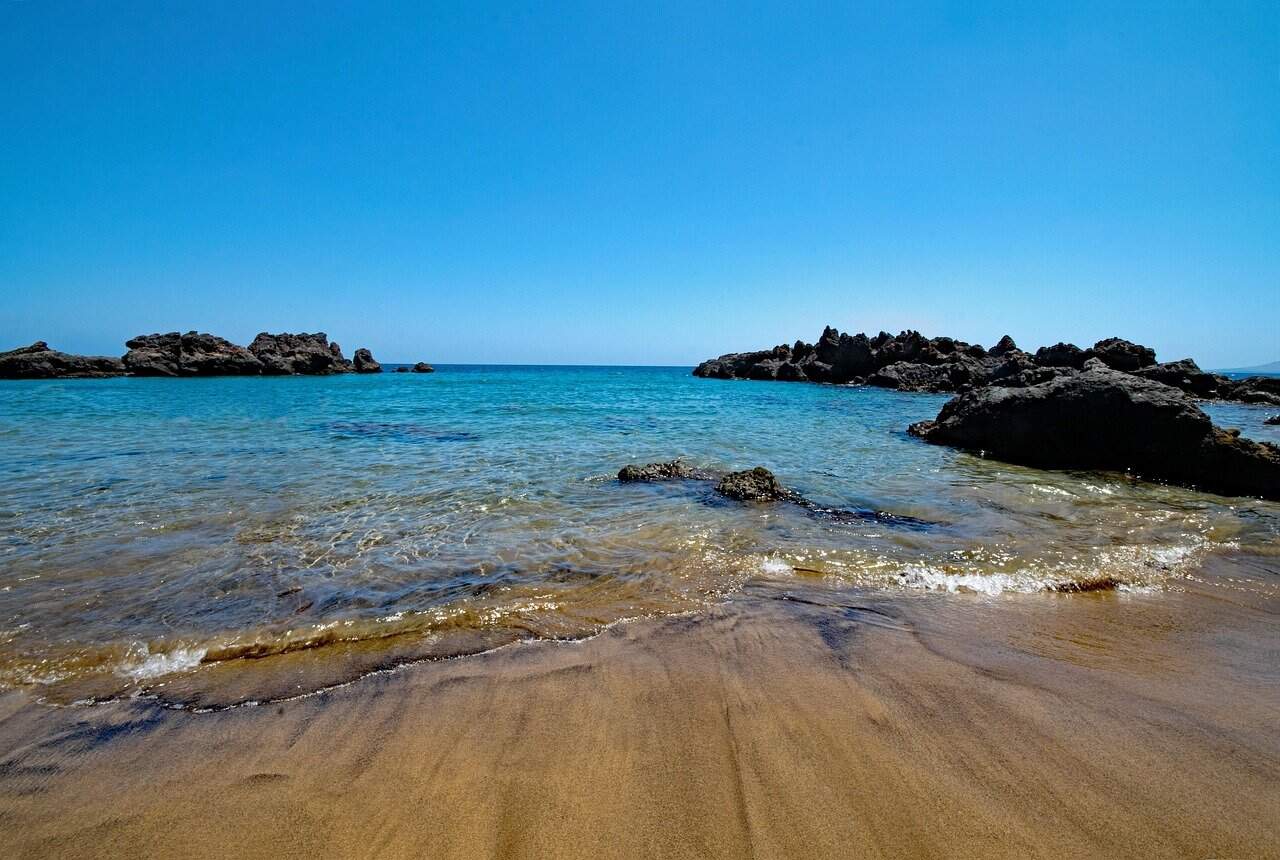
Beaches you can visit in the Canaries
Did you know that in the Canaries there are black, white… and red sand beaches? The chromaticity of its shores is not marketing, it's pure geology at its best. Volcanoes, seashells, living dunes, and even massive algae buildups have painted the coastline of the archipelago with an unusual palette. Walking on these beaches is to traverse millions of years of history concentrated in grains of sand.
The scene repeats with surprising nuances, turning the islands into true paradisiacal beaches. Stepping onto a volcanic beach, the sand heats up faster and crunches with a deep sound. The white jable of Fuerteventura, on the other hand, sinks softly, reflects light, and paints the water turquoise. And now and then, a beach awakens with temporary greenish hues due to algae accumulation. Small details that, for the curious traveler, completely change the experience.
The Canaries are an open-air natural laboratory. And their colored beaches are the gateway.
- Black: spread throughout the archipelago, the result of fragmented basalt. Tenerife, La Gomera, La Palma, El Hierro, and Gran Canaria are home to dozens of examples.
- Golden and white: they thrive in Fuerteventura and part of Lanzarote, where marine bioclasts and dunes shape coastlines with clear waters.
- Red: volcanic rarities, like El Verodal in El Hierro, tinted by iron oxides.
Quick guide to uniquely colored beaches
Below is a selection that combines chromatic variety, accessibility, and visiting styles. Some are urban, others wild. All leave a mark on the memory.
| Island | Beach | Sand color | Access | The best for you |
|---|---|---|---|---|
| Tenerife | Las Teresitas (San Andrés) | Imported golden | Road and urban bus | Family day, calm sea, palm trees, and full services |
| Tenerife | Roque Bermejo (Anaga) | Volcanic black | On foot or by boat | Silence, coastal hiking, rugged landscape |
| La Gomera | La Caleta de Hermigua | Volcanic black | Road and short walk | Natural environment, moderate waves, no artifice |
| La Palma | Charco Verde (Puerto Naos) | Fine black sand | Accessible, boardwalks | Calm swimming, agricultural surroundings with banana plantations |
| El Hierro | El Verodal (La Frontera) | Volcanic red | Simple path | Photography and contemplation, virgin beach between cliffs |
| Gran Canaria | Maspalomas | Golden, living dunes | Very easy | Walks through a protected dune field and unmatched sunsets |
| Gran Canaria | La Garita (Telde) | Volcanic black | Urban and accessible | Surfing and bodyboarding, services, and local life |
| Fuerteventura | Sotavento (Pájara) | White jable | Road and parking | Kitesurfing and windsurfing, inner lagoons with tides |
| Fuerteventura | La Concha (El Cotillo) | White jable | Easy, next to the village | Very calm turquoise waters, ideal with little ones |
| Lanzarote | Papagayo (Yaiza) | Golden | Path and parking | Protected coves, snorkeling and a feeling of refuge |
A rainbow in the sand that has an explanation
The colors are not random. Each shade holds an origin:
- Intense black: comes from the disintegration of basalts and pyroclasts, volcanic rocks rich in dark minerals like magnetite, augite, and hornblende. The waves crush the lava, and the current selects the heaviest grains that accumulate on the shore.
- Bright white: comes from calcium carbonate, that is, fragments of shells, corals, and marine organisms. In Fuerteventura, this biogenic granule is called jable. Its high albedo makes the water appear impeccably turquoise.
- Warm gold: it can be a mix of light grains of marine origin with siliceous fragments, in addition to desert sands transported by wind or deposited, as happened in Las Teresitas in the seventies.
- Vivid red: iron oxides and hydroxides stain the sediment. The erosion of flows with oxidized iron generates orange and reddish sands, a spectacle under clear skies.
- Occasional green: olivine, a common mineral in mafic rocks, provides greenish flashes in isolated grains. The massive phenomenon of green sand does not occur steadily on the islands, although there are episodes when the accumulation of algae or cyanobacteria colors the beach for days.
Small differences that change the experience
The physics of color is noticeable on the soles of your feet. Dark sands absorb more solar energy, so they heat up faster and can be uncomfortable during the peak hours. Light sands reflect light, temper contact, and shape Caribbean tones in the water. And there are subtle nuances: the shape of volcanic grains is usually angular and rough, while jable tends to be rounded and smooth.
Chemistry also changes. The pH and mineral content of the sediment, together with temperature and wave action, influence which algae, invertebrates, and fish prefer each environment. Under the same sun, life organizes in very different ways.
Access, services, and rhythms
The range is wide, and it's advisable to choose according to expectations:
- Urban and complete: Las Teresitas or La Garita provide parking, showers, lifeguards, beach bars, and adapted access. Ideal for spending the day in comfort and leisure without giving up a safe swim.
- Natural and discreet: Roque Bermejo or El Verodal, located amidst the beauty of the Mediterranean Sea, require planning. Sometimes they lack coverage, shade, or lifeguards. What they offer in return is silence, sculptural rock formations, and vast skies.
- Active and sporty: The beaches of Sotavento concentrate constant winds, kitesurfing and windsurfing schools, and a calendar that attracts athletes from all over the planet.
- Postcard-worthy and snorkel-friendly: Papagayo, with coves that look like amphitheaters, allows swimming in calm, clear waters, perfect for observing fish over sandy and rocky bottoms.
Suggestions for organizing your visit
- Check the wave and wind report. On open Atlantic beaches, the sea can change within hours.
- Wear amphibious footwear in rocky areas or with shallow waters.
- In summer, bring a beach umbrella and broad-spectrum mineral sunscreen. Dark sands heat up quickly.
- If you move with a wheelchair or stroller, look for walkways and amphibious chairs available at several beaches with Blue Flag.
- Respect signage. Some areas protect bird nests, dune plants, or underwater meadows.
Ecosystems that pulse beneath your feet
Each color fits into a vibrant mosaic.
In golden dunes like Maspalomas or Corralejo they thrive in plants adapted to aridity and saline winds, many of which are endemic. Among bushes and coastal ravines, migratory birds slip in, using these systems as a service station on their routes.
In sand dunes and protected bays, seagrass meadows, especially Cymodocea nodosa, act as nurseries. Juvenile fish find refuge, bringing with them a chain of life that supports artisanal fishing and biodiversity.
On cliffs of volcanic rock, the crevices hold a resilient rock flora and a surprising microfauna. The natural pools formed by flows that cooled upon contact with the sea, host communities of algae, small crustaceans, and very specific mollusks.
And on black beaches, where heavy grains are concentrated by the energy of the waves, the nearby bottom is often steep and hosts communities of rock-loving invertebrates. There, snorkeling reveals diadems, old wives, and salemas among contrasting shadows.
Colors with geological history
- Volcanoes that feed the coast: ancient flows and recent cones erode with the sea, releasing minerals that the waves select by density.
- Migrating dunes: coastal dune systems move with the wind, recycling sand and reconfiguring beaches from season to season.
- Saharan dust: episodes of hazy dust deposit fine particles over the islands. Sometimes the traces remain in protected sand areas.
- Algae arriving with the currents: calm tides can accumulate algae and cyanobacteria on the sand, temporarily altering its color and smell. It’s not always degradation; often it’s a natural pulse of productivity.
Color routes for a weekend
Simple proposals for a vacation, without hurry, savoring every corner.
- Northern Tenerife and Anaga
- Morning: gentle trail to Roque Bermejo, swimming if the sea allows.
- Afternoon: return to Santa Cruz and a long evening in Las Teresitas, beach bar at sunset.
- Eastern Fuerteventura
- Morning: walk through Sotavento with the tide rising to see the lagoon forming.
- Afternoon: El Cotillo and its La Concha beach, calm snorkeling and dinner in the village.
- Southern Lanzarote
- Morning: walk among the coves of Papagayo, from cove to cove without a clock.
- Afternoon: visit to salt flats and a brief stop at Famara to understand the contrast of an open beach to the Atlantic.
- Unique El Hierro
- Morning: photo stop at El Verodal, absolute respect for the currents.
- Afternoon: natural pools on the northern coast to contemplate the ocean from a volcanic pool.
Tourism and conservation: necessary balance
Beauty is fragile if the use of tourism on beaches is intensive. There are impacts that it is advisable to know in order to make better decisions.
- Sand extraction and works: modifying the sediment balance alters the beach profile. Regenerating by adding external sediments can solve specific problems, but it also changes the grain size and the fauna linked to the substrate.
- Trampled dune systems: leaving the paths breaks key vegetation and accelerates erosion. Walkways are not a whim; they are the lifeline of the dunes.
- Vulnerable marine meadows: indiscriminate anchoring tears up rhizomes and opens clearings in the sea. Low-impact buoys and regulated anchoring make a difference.
- Waste and microplastics: tourist activity translates into fibers, wrappers, and cigarette butts. The best waste is the one that doesn't reach the beaches.
Good news: the archipelago has multiplied protected areas, a network of marine reserves, Blue Flag programs, accessible walkways, and environmental education on-site. In several municipalities, you'll find ashtray loan points, signage that informs about dune flora, and patrols that watch over nesting birds. Active tourism is also growing, understanding that a photo is worth more without stepping on a cardonal.
Tips for enjoying without leaving a trace
- Opt for mineral and biodegradable sunscreen, better for the meadows and wildlife.
- Do not uproot plants or move stones. A crab refuge is a small world.
- Avoid anchoring over seagrass beds. Use designated buoys or anchor in free sand.
- Reduce single-use plastics. Bring a reusable water bottle, tupperware, and reusable bags.
- Stay on paths and walkways in dunes. If you see stakes and ropes, respect the area.
Small scientific notes that are noticeable on the towel
- Granulometry: the grain size determines how it feels underfoot, how the towel dries, and how the wave breaks. Fine sand, gentle slope, and soft breaking usually go hand in hand.
- Mineral density: beaches with heavy minerals retain grains in swells and show more pronounced black bands after storms.
- Temperature and comfort: at noon, black sands can be scorching. Plan barefoot walks in the morning and at sunset.
- Water optics: clear bottoms intensify blue and green. On black beaches, the contrast creates a deep blue that shines with high sun.
What to bring for each color
- Black: water shoes, sturdy umbrella, plenty of water.
- White: sunglasses with good filters, sunscreen, cap.
- Gold with dunes: light bag, sense of direction, respect for ropes and walkways.
- Red: camera, footwear for volcanic terrain, attention to maritime reports.
Any given day, in a corner of the Canary Islands, the wave sounds brief and rhythmic over black grains, then golden, beyond white, and perhaps this week with a greenish veil on the surface, inviting participation in water activities. The sky clears the horizon and the volcanoes, old and young, seem to be discreet guardians of the shore.
If you are attracted by the idea of stepping on sands that tell stories, the archipelago makes it easy. All you need is time, curiosity, and an active respect for what makes these beaches unique. The unforgettable feeling of coming out of the water and looking at the palm of your hand, where grains that have traveled from the heart of the island to the shore shine, sticking to your skin, will be your clearest memory. And you'll want to return to see what color awaits you next time.