
Preservation of spiritual heritage through ancestral rituals
La Palma, known as 'The Beautiful Island' for its stunning landscape and biodiversity, is also a true sanctuary of customs that have withstood the challenges of time. Beyond its volcanic beauty and starry skies, on this Atlantic island, a community life marked by rituals is celebrated, passed down from generation to generation. These are celebrations that not only evoke devotion but also a sense of belonging and a palpable connection to ancestors through ancestral practices.
The pulse of island tradition
In the heart of La Palma, the collective soul is woven through a series of rites that sprinkle the calendar and the imagination of its inhabitants. Old legends, religious symbols, and gestures full of meaning intertwine in public acts, prayers, and small family customs.
It would be difficult to walk through the towns and not perceive the anticipation when the date of one of these festivities approaches. The energy transforms, and the streets are tinged with respect and joy. The preparation for the festivities involves everyone: young and old share tasks, traditional costumes are dusted off, and the faithful prepare to follow the rhythm of a story that seems endless.
A celebration with centuries of history
Of all the festivals, probably none represents the palmero spirit as well as the Bajada de la Virgen de las Nieves. It is organized every five years, bringing together thousands of neighbors and visitors who come to be an active part of this special event.
In the weeks leading up to it, the sacred image is brought down in procession from its sanctuary to the capital, Santa Cruz de La Palma. This journey, filled with emotion, is accompanied by songs, prayers, and the characteristic ringing of drums and chácaras. The island comes to a halt to pay homage to its patroness, in an act that encompasses both religion and social manifestation.
Main components of the Bajada:
- Processions and romerías: Solemn and festive routes, with the image of the Virgin accompanied by the crowd.
- Ancestral dances: Among them stands out the traditional 'Dance of the Dwarfs', a symbol of ingenuity and surprise.
- Floral offerings and vows: Acts of gratitude and petition.
- Music and traditional attire: To the rhythm of folías, sorondongos, chácaras, and drums.
- Gatherings and communal meals: Spaces for meeting to share and strengthen ties.
These elements not only underscore devotion but also keep alive the bonds between generations.
Religion and protection: faith as a shield
It is no coincidence that so many of these practices are tied to religion. The history of the island is marked by episodes of uncertainty: volcanic eruptions, invasions, diseases. In the face of adversity, the community found in religious rituals both a means of seeking protection and a way to reinforce their identity.
Devotions, processions, and offerings go far beyond mere formality. They are declarations of intent before the universe; acts that harmonize the desire for survival with collective hope. When younger generations raise their prayers alongside the elders, a fundamental continuity for the people is established.
Example of an ancestral ritual associated with protection:
| Ritual | Brief description | Main meaning |
|---|---|---|
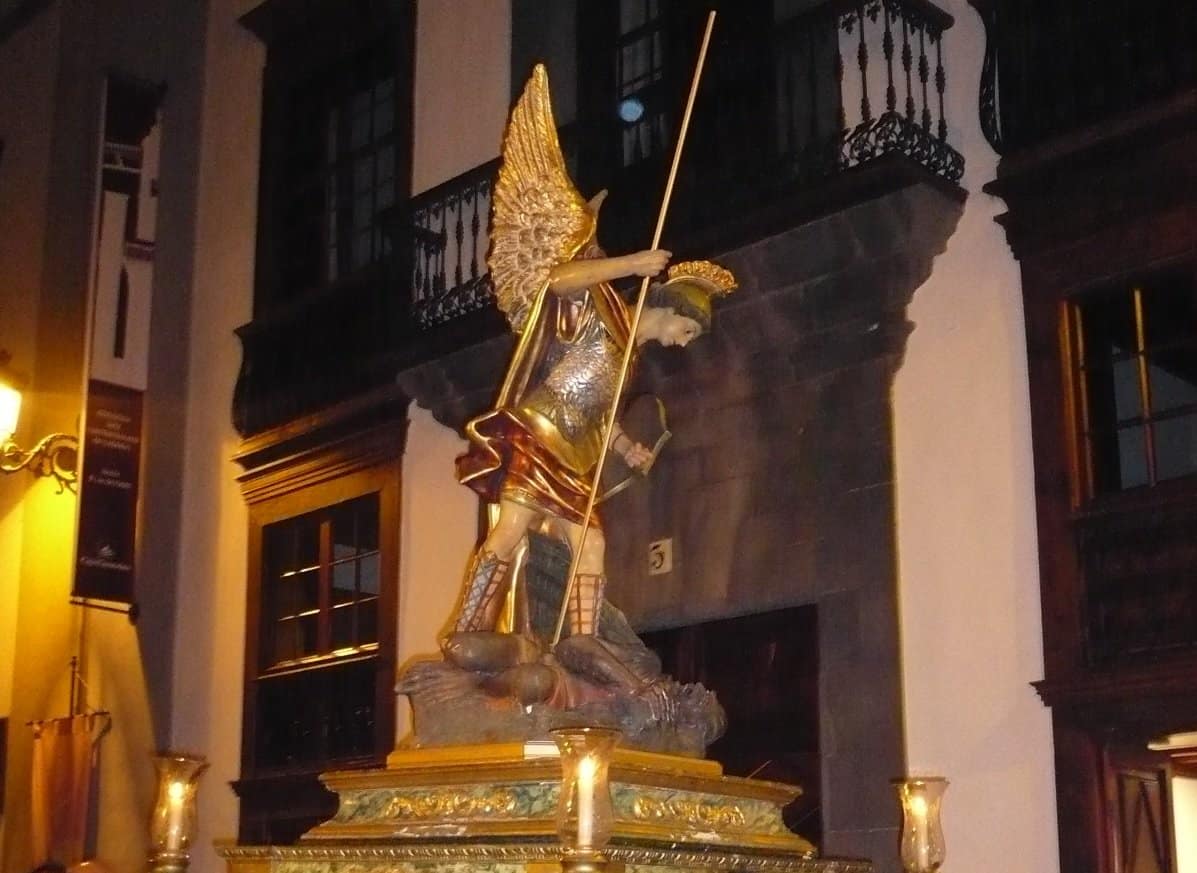
| Procession of Saint Michael | Walk with the image of the patron saint | Seeking favor and guardianship |
| Offering of flowers | Bringing flowers to the church | Thanksgiving and supplication |
| Solemn masses | Massive religious acts | Spiritual union of the community |
Dance and song: the living language of memory
Not everything in these festivals revolves around solemnity. There is also space for festive expression, including traditional masquerades. Traditional dances, accompanied by popular songs, represent a joyful and bold way of transmitting cultural heritage. The palm bearers dominate steps and melodies that date back centuries and resonate even with the youngest in the household.
A singular example is the 'Dance of the Dwarfs,' in which a group of disguised men transforms into tiny dancing figures through a performance that does not lose its magic, no matter how many times it is repeated. This mystery, orchestrated over generations, astonishes the audience and reinforces the idea that popular knowledge is a treasure that can only be preserved by sharing it.
The songs, accompanied by lute, guitar, and accordion, carry messages of hope, nostalgia, love, and humor. They are authentic sung tales that evoke rural life, work in the fields, and community bonding.
Spirituality, but also social function
The extraordinary thing about these ceremonies and rituals is that, while they arise from deep spirituality, their impact goes far beyond the religious. They serve a central function in group cohesion. Gathering to organize, celebrate, and fulfill promises strengthens bonds and reduces distances between neighbors.
For example, before the grand festival, families open their doors to acquaintances and even strangers. Sharing meals, laughter, and tasks is the cornerstone of these traditions, helping to heal potential differences and reminding that the community is, in fact, a large family.
The benefits of these rituals also extend to the emotional realm: they provide a space for healing, comfort in the face of loss, and reinforcement in the face of life’s difficulties, both personal and collective.
Transmitting the legacy: the importance of example
None of this would be possible without an active commitment to generational transmission. It is not enough to remember stories; it is essential for the elders to directly guide the younger ones in the participation, saving, and creativity necessary to keep the tradition alive.
Some transmission methods include:
- Dance and singing workshops held in local schools
- Making costumes and ritual objects within the family
- Small theatrical performances of songs and legends
- Intergenerational coexistence days during the preparations
Teaching is not limited to folklore; it also involves values such as solidarity, patience, and respect for diversity.
A magnet for the curious visitor
The uniqueness of these practices serves as an attraction for those seeking deeper meanings in their travel experiences. Each year, many travelers, both national and international, come to La Palma to witness the Bajada de la Virgen de las Nieves and other festivities with ancestral roots. The atmosphere is authentic, without the gloss of excessive commercialization.
The economic and social repercussions of this external interest are noticeable. Tourism nourishes the authenticity of La Palma, while also helping to enhance and protect a way of life that could otherwise be threatened by forgetfulness. Artisans, musicians, and cultural guides find in these celebrations an opportunity to showcase their work and, at the same time, continue learning.
Preservation in the 21st century
Globalization and new ways of living present challenges for the survival of ancestral rituals. However, the Palmese society has shown a remarkable ability to combine the new and the old.
It is not unusual today to see social media accounts dedicated to promoting festivals, as well as documentaries made by local youth striving to archive and share the stories passed down from their grandparents.
Respect for nature, creativity in the reuse of materials, and the integration of contemporary elements into ancient rituals highlight an intelligent adaptation, enriched by local mythology. Thanks to this, the essence of tradition remains intact, regardless of social changes.
Beyond the festivity: a way of being
In La Palma, ritual and daily life intertwine to the point that, for many, participating in these celebrations is not an obligation but a way of understanding their role in society. The sense of belonging and cultural pride foster collective self-esteem, while the gaze towards the past becomes a driving force for the future.
These rituals not only reference local history but also a model of coexistence based on empathy, respect, and collaboration. Keeping these practices alive is, ultimately, a real and conscious way of safeguarding something more valuable than any monument or relic: the very soul of La Palma.